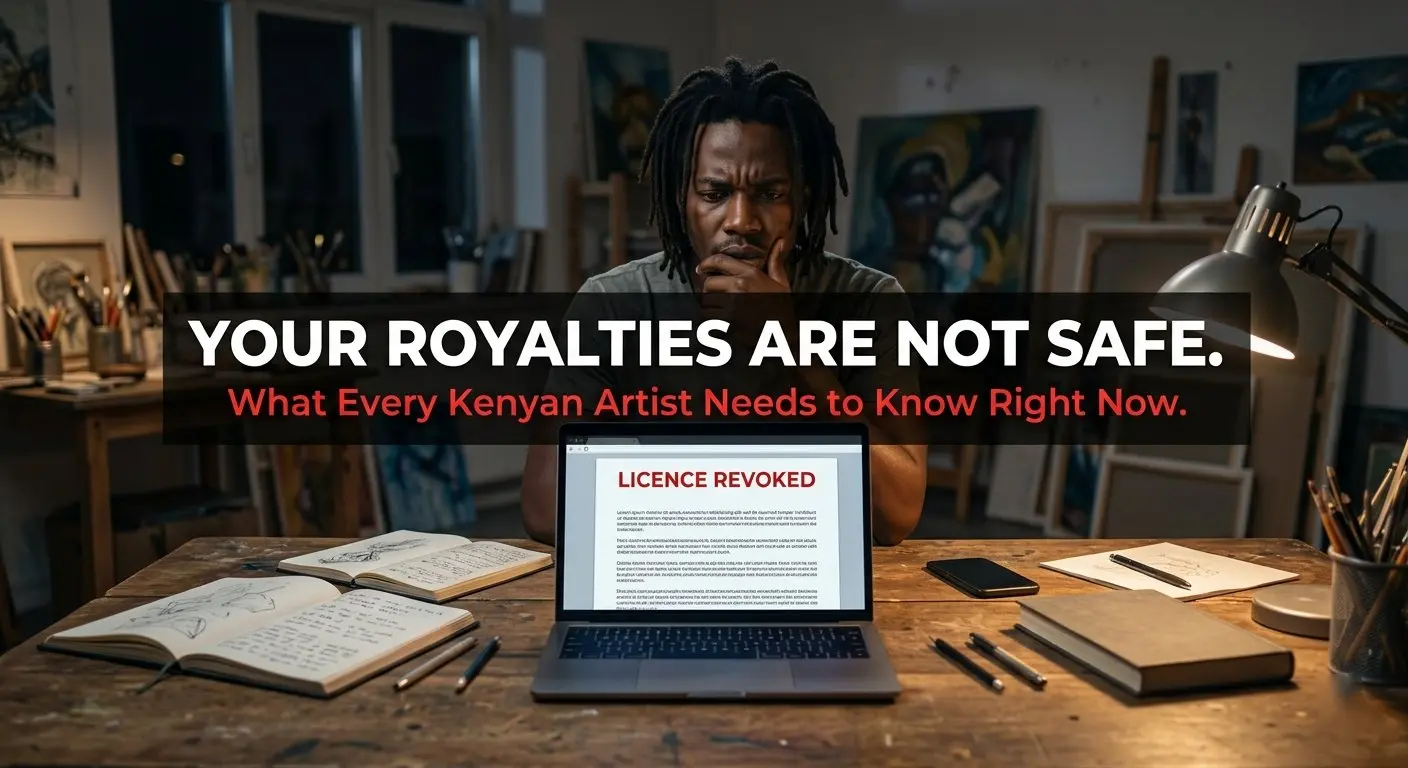
If you are a Kenyan artist and you have been trusting MCSK to collect your royalties, this post is going to be uncomfortable to read.
Read it anyway.
The High Court has ruled that MCSK can no longer collect money from businesses and individuals using music in Kenya. The ruling came after the Kenya Copyright Board refused to renew MCSK's licence for 2025 to 2026 following the organisation's failure to submit certified annual returns and audited accounts for five consecutive years. The NATIVE
Five years. Not one year of missing paperwork. Not a minor administrative oversight. Five years of an organisation that holds the royalty rights of thousands of Kenyan artists failing to produce the basic documentation that proves it is handling that money properly.
MCSK was additionally accused of financial misappropriation for failing to account for Ksh 56 million in artist royalties. Afrocritik
Fifty-six million shillings. Belonging to Kenyan artists. Unaccounted for.
And the organisation still tried to keep collecting.
What Has Actually Happened, In Order
Because the legal timeline of this story matters and most artists have only heard fragments of it, here is exactly how we arrived at where we are today.
On October 14, 2025, KECOBO officially rejected the renewal application of MCSK. The regulator licensed only two entities: the Performing and Audio-Visual Rights Society of Kenya, known as PAVRISK, and the Kenya Association of Music Producers, known as KAMP. GRAMMY
On October 31, 2025, the Copyright Tribunal discharged an interim order that had briefly allowed MCSK to continue operations. GRAMMY
On December 15, 2025, High Court Judge Justice Linus Kassan declined to stay the Tribunal's decision, directing that the main dispute proceed to a full hearing in July 2026 and leaving the ban on collection firmly in place. GRAMMY
On January 21, 2026, Justice Patrick Otieno struck out a constitutional petition filed by MCSK members, ruling that the High Court lacked jurisdiction and that the petitioners had not exhausted the dispute resolution mechanisms provided by the Copyright Tribunal. GRAMMY
On February 13, 2026, the High Court in Milimani issued a fresh warning to MCSK, affirming that the society has no legal right to demand music usage fees, copyright fees, or licensing charges without a valid licence from KECOBO. GRAMMY
At every stage, at every court level, the decision has been the same.
MCSK cannot legally collect your royalties.
A full hearing is now scheduled for July 21, 2026, where all parties will present their arguments in detail. Until then, MCSK remains barred from collecting any music-related fees. GRAMMY
What This Means for 16,000 Kenyan Artists
MCSK members themselves argued in court that the non-renewal had effectively paralysed the organisation's operations and deprived more than 16,000 artists of their royalties. Afropop Worldwide
Sixteen thousand. That number includes established names and debut artists. It includes producers and composers and performers who registered with MCSK in good faith, trusting that the organisation would be the bridge between their music being played and their money arriving.
That bridge is currently legally collapsed.
KECOBO has issued a clear warning to the public: paying MCSK for royalties is now illegal. Businesses and individuals who continue to pay MCSK risk paying twice, once to an unlicensed organisation that cannot legally distribute the funds, and again to PAVRISK, the legitimate body now authorised to collect and manage royalties. The NATIVE
That warning is aimed at businesses. But the implication for artists is equally stark.
If a business is paying MCSK despite the warnings, that money is going into an organisation that has no current legal pathway to distribute it to you. And if that business is paying PAVRISK instead, the royalties only reach you if you are registered with PAVRISK and your music is properly documented in their system.
The question every Kenyan artist needs to answer honestly right now is: do you know exactly where your royalties are being collected, by which body, and whether your music is properly registered with the right organisation?
Most artists do not know the answer to that question. The MCSK situation has exposed that clearly.
The Deeper Problem This Exposes
The MCSK crisis is not just about one organisation's governance failures. It is about a structural vulnerability that every artist who relies entirely on collecting societies to manage their income is exposed to.
Kenya's music licensing rules are in flux. The question of who can legally collect royalties must be treated as date-stamped information that can change with the next hearing, the next tribunal ruling, or the next court decision. Artist Heat
Read that carefully. The legal landscape around royalty collection in Kenya is shifting in real time. The organisation most Kenyan artists trusted for years to handle their broadcasting and performance royalties does not currently have legal authority to do so. The full hearing is six weeks away. Nobody can tell you with certainty what the ruling on July 21 will produce.
An artist whose only income protection is a collective management organisation operating in this environment is an artist with no current income protection at all.
This is not a criticism of every artist who registered with MCSK. It was the obvious and reasonable thing to do. What the crisis reveals is something that applies beyond MCSK, beyond Kenya, and beyond any single moment in the legal calendar.
Institutions can fail. Licences can be revoked. Courts can issue orders that freeze distribution overnight. The artist who has built direct income streams alongside their collecting society registration is in a fundamentally different position from the artist whose entire royalty expectation runs through a single institutional channel.
What You Need to Do Right Now
Step one. Establish whether your music is registered with PAVRISK, which is the currently licensed collecting society in Kenya alongside KAMP for producers. If you are not registered with PAVRISK, your performance and broadcasting royalties currently have no legal collection pathway in Kenya.
Step two. Audit your streaming royalties separately. Your Spotify, Apple Music, Boomplay, and Audiomack royalties flow through your distributor, not through MCSK or PAVRISK. This income stream is unaffected by the current legal situation but only reaches you if your music was properly distributed with clean documentation from the start.
Step three. Understand what you actually own. The royalty crisis has exposed how many Kenyan artists do not have full visibility into what rights they hold, what their licences cover, and what documentation supports their claims. This is not a comfortable conversation but it is the one the industry now requires.
Step four. Build income that does not depend entirely on collecting societies. Direct licensing, sync placement, proper beat licensing if you are a producer, and direct-to-fan relationships are all income streams that no tribunal ruling can interrupt.
The One Thing Nobody Is Saying Out Loud
The MCSK situation is a systemic failure. It is not primarily the fault of the thousands of artists who registered in good faith. They did what they were supposed to do inside the system that existed.
But the system failed them. And the lesson, uncomfortable as it is, is that a music career built entirely on the expectation that institutions will behave correctly is a career with an exposure that the institution's lawyers understand far better than most artists ever will.
The artists in East Africa who are building properly right now are building multiple layers. Streaming income from properly distributed records. Collecting society registration with the currently licensed bodies. Direct licensing of their music for commercial use. And at the foundation of all of it, a clear record of what they own and the documentation to prove it.
That documentation starts with the first record. The first beat licensed properly. The first release where every element has a paper trail.
At mBeatz, every beat in the catalogue comes with an instant licence document. Not as a legal nicety. As the first layer of the ownership structure that protects everything built on top of it. The MCSK situation has shown exactly what happens when that structure is missing or compromised at any level.
Build your structure correctly from the first note.
Important note: The MCSK case has a full hearing scheduled for July 21, 2026. This post reflects the legal situation as of June 2026. Artists should follow updates from KECOBO directly at kecobo.go.ke for the most current guidance on royalty collection in Kenya.
Have you been affected by the MCSK situation? Tell us in the comments how you are managing your royalties right now.

0 Comments
Leave a Comment