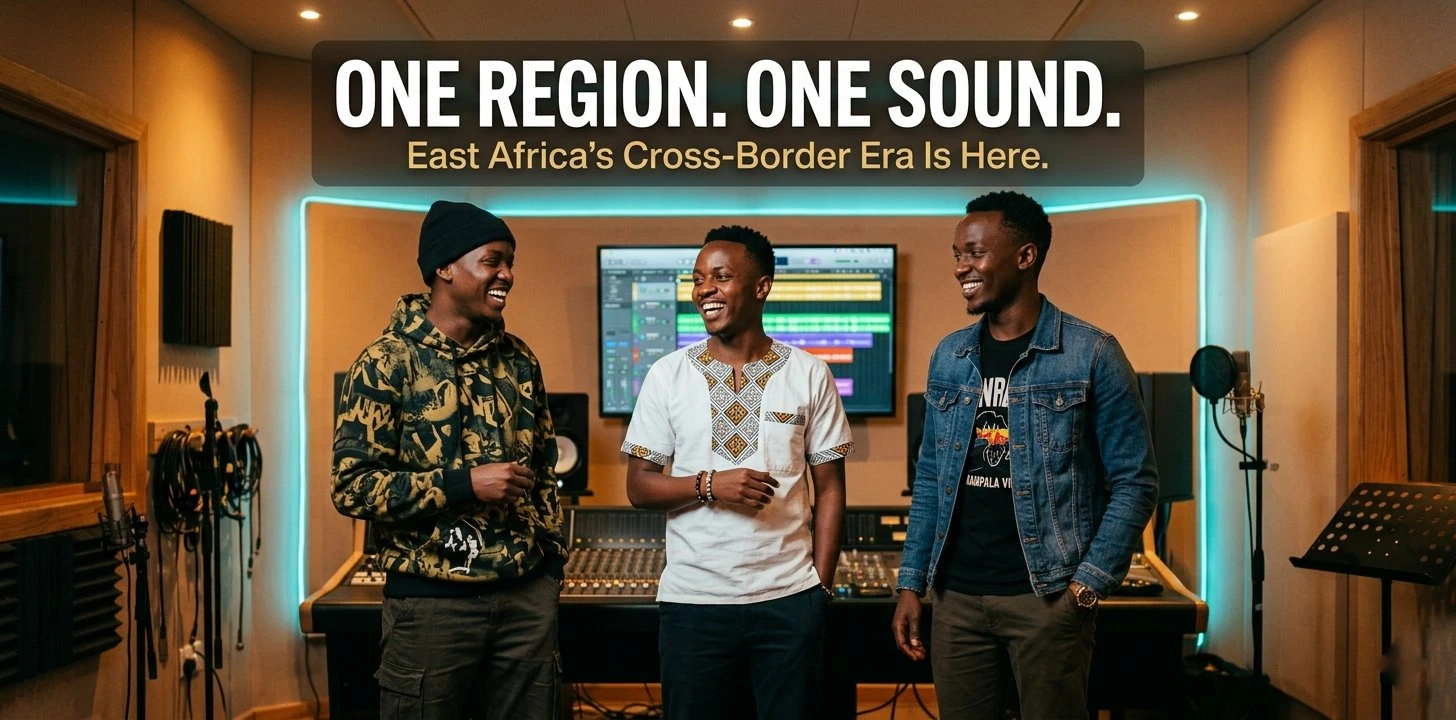
Pay attention to what Element Eleéeh is building.
The Rwandan producer did not release a Rwandan record. He pulled Kenya's Bien and Uganda's Joshua Baraka into a single track called "AYAYAAH" and dropped something that no single country can fully claim and every country immediately felt.
As Element Eleéeh told OkayAfrica earlier this year, 2026 is the moment he is fully prioritizing his solo artist career, thinking beyond the local scene, and chasing music that can last. Showcase Africa
Music that can last. That phrase is doing serious work in 2026. And the artists who are building for longevity have all arrived at the same conclusion independently: the East African region is a single audience wearing five different flags, and the records that treat it that way are the ones the algorithms cannot stop pushing.
The Shift Happening Right Now in Real Time
April 2026 stretched the map of what East African music can sound like. The month's standout releases span Bongo Flava romance, Kigali cool, Kenyan rap virality, and diasporic experimentation, with artists across the region sounding more willing than ever to collaborate and explore new moods. Showcase Africa
That is not a coincidence. It is a collective reading of the same data.
Streaming platforms track saves, skips, repeat listens, and playlist additions by country. When an East African record performs in Kenya, the algorithm does not stop at the Tanzanian border. It follows listening behavior across the region and beyond. Artists who have been releasing music long enough to watch their analytics understand that their Kenyan fans and their Tanzanian fans and their Ugandan fans are sitting in the same playlists, responding to the same sonic cues, and sharing music across WhatsApp groups that have no regard for national boundaries whatsoever.
The cross-border collaboration is simply the most efficient way to reach all of them at once.
The Records Proving It This Month
"Lete Sound" features Ben Pol bringing Tanzanian smoothness and Juliani adding Kenyan weight and personality, turning a global dance production into something with genuine regional shape and identity. Showcase Africa
Two artists. Two countries. One record that lands on both countries' trending pages simultaneously. The math is not complicated.
Blinky Bill and Muthoni Drummer Queen linked up for a joint project called "Now It's Experience Talking," a conversation between two artists who have done as much as anyone to shape Kenya's alternative music scene. When veterans collaborate, the message sent to newer artists is equally loud: the era of competing within your own city is finished. The competition is continental now and the collaborations are the answer. Showcase Africa
MATATA brought in Marioo on "Nyongi," a natural cross-border link-up that extended the group's reach directly into Tanzania's most active streaming audience. Marioo's name in the credits is not just a feature. It is a distribution strategy wearing a creative hat. OkayAfrica
And then there is the record that quietly said something larger than any of the others. "AYAYAAH" by Element Eleéeh, featuring Bien from Kenya and Joshua Baraka from Uganda, built toward a debut album that looks increasingly regional in both sound and ambition. Rwanda producing. Kenya singing. Uganda featuring. The entire East African landmass represented in a single three-minute record. Showcase Africa
Why the Beat Has to Be Built Wide Enough to Hold All of This
Here is the production reality behind every successful cross-border East African record that nobody talks about.
The beat has to work across accents, across delivery styles, across the specific rhythmic instincts that a Nairobi artist and a Dar es Salaam artist and a Kampala artist each bring from completely different musical upbringings.
A Kenyan artist and a Tanzanian artist do not approach melody the same way. They do not phrase their Swahili the same way. They do not sit in a groove the same way. The Bongo Flava influence that shapes how a Tanzanian vocalist hears a beat creates different natural entry points than the Gengetone and hip-hop hybrids that trained the Kenyan ear.
A beat that is too narrow, too stylistically specific, too locked into one country's production signature, forces one of the collaborators to work against their instincts. And when an artist is working against their instincts, the listener feels it even if they cannot name it. The energy is slightly wrong. The chemistry is slightly forced. The record works but does not soar.
The records that are doing damage right now, the Element Eleéeh records, the Ben Pol and Juliani records, the Bien and Alikiba records, are built on instrumentals wide enough to give every voice its own lane. That is not an accident of talent. It is a deliberate production decision made before a single vocal was recorded.
What This Means for Every Artist Reading This in 2026
The cross-border strategy is not reserved for artists who already have a following in multiple countries. It is available to artists who are just starting, because the infrastructure that makes it possible has nothing to do with an existing audience.
It starts with the beat.
A properly produced Afro-pop or Bongo Flava-influenced instrumental that sits in the sonic space where East African music lives right now, not trying to sound specifically Kenyan or specifically Tanzanian but drawing from the full regional palette, is a record that a collaborator from anywhere in the region can step onto naturally.
That is the first decision. Find the beat that holds the vision wide enough for more than one voice.
The second decision is the collaboration itself. What can we expect from East African music in 2026? More interregional and cross-continental collaborations. Artists playing with and sampling other genres. A new guard of artists pushing boundaries and reimagining what it means to be rooted in tradition, bringing innovation, experimentation, and a fearless reclaiming of what is already known. TNX Africa
The third decision is ownership. A cross-border collaboration that is built on a properly licensed beat, with a clear licence document from the start, means that when the record finds its audience across three countries simultaneously, every stream, every playlist addition, every royalty payment routes correctly to the people who made it.
A free beat with no documentation cannot survive the complexity of a cross-border release. When Content ID matches fire across multiple territories at once, the artist without a licence document loses everything in every territory simultaneously.
The artists moving correctly in 2026 are solving the beat, the collaboration, and the licence before they enter the studio. In that order.
Build the Record That Three Countries Will Claim
At mBeatz, the catalogue is built exactly for this moment. Afro-pop instrumentals, Bongo Flava-influenced beats, Afro-house productions, and everything living in between, all produced with the sonic width that East African cross-border records demand.
Every beat includes instant WAV delivery and a full licence document. Whether you are in Nairobi building toward a Tanzanian feature, in Kampala chasing the sound that Rwanda's producers are pioneering, or anywhere in between, the foundation starts with the right instrumental.
Element Eleéeh thought regionally before he ever pressed record. Ben Pol and Juliani looked across the border before they wrote a single line.
The artists who will define East African music by the end of 2026 are making that same decision right now, today, with the beat they choose tonight.
Find your cross-border sound at mBeatz. Browse the full catalogue here.
Which cross-border East African collab has hit hardest for you in 2026? Drop it in the comments.
.jfif)
0 Comments
Leave a Comment