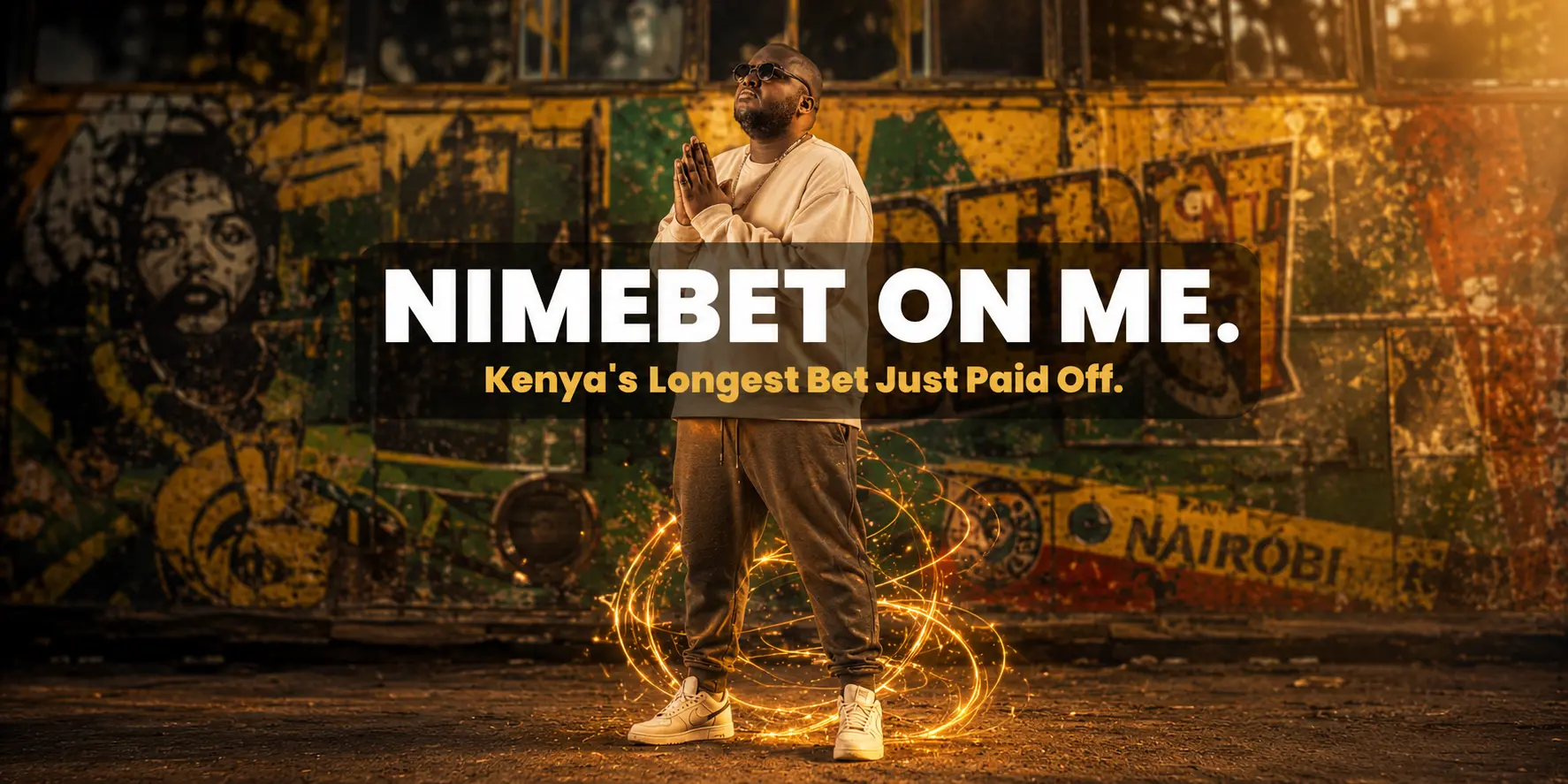
The first bar of "Kale Ka Uoga" lands before you have time to prepare for it.
"Nimebet on me so siwezi kubali kuloose."
I have bet on myself so I cannot accept losing.
Mejja, one of Kenya's most respected Genge artists whose career spans over a decade, said those words in 2026 on the third track of his debut album. GRAMMY
His debut album.
Major Nameye Khadija, born May 23 1986, began his music career in primary school performing with his brother in a group called Ghetto Clan. He had his first breakthrough in 2008 with "Jana Kuliendaje." He formed The Kansoul in 2014. He collaborated with Trio Mio, Femi One, Bensoul, Sauti Sol. He became one of the most featured voices in Kenyan urban music. eiiGhana Africa
All of that happened before a single solo album existed.
Nineteen years of showing up. Nineteen years of collaborating, building, betting on himself quietly, methodically, without the validation of a project with his name alone on the cover.
Then in March 2026, "Mtoto wa Khadija" arrived.
And the first thing he said was: I bet on myself and I refuse to lose.
What the Title Means Before You Hear a Single Note
Mejja's debut album "Mtoto wa Khadija," a 13-track collection, showcases his unique style and storytelling ability, blending catchy beats with relatable lyrics. Artist Heat
"Mtoto wa Khadija" means Child of Khadija. His mother's name. A debut album named after the woman who raised him, released at 39, after nearly two decades of being one of the most recognizable voices in Kenyan music without ever being the sole name on an album cover.
That decision tells you everything about what kind of artist Mejja is before you press play.
He was not in a rush to release something unready just to say he had released it. He was not chasing a moment because the industry expected one. He moved when the music was right, when the stories were fully formed, when he had something to say that required thirteen tracks and his mother's name to say it properly.
In an era where artists are pressured to release constantly, to feed algorithms with volume regardless of quality, Mejja did the opposite. He took his time. He made it mean something.
And Kenya heard it immediately.
"Kale Ka Uoga" Is Not Just a Song Title
The title "Kale Ka Uoga" explores facing old fears through Genge beats mixed with hip-hop, with Mejja sharing stories of city hustle while Scar Mkadinali drops bars full of precision. Fans praise the honest Kenyan flavor and the inspiring message about overcoming challenges. Spotify
Old fear. The fear that existed before. The fear you carry from the block, from the early years, from the times things did not work the way you planned them.
The song brings together Mejja's signature witty storytelling and Scar Mkadinali's sharp rap delivery, creating a vibrant fusion of Genge and modern East African hip-hop. Blending Genge, hip-hop, and Afro-urban sounds, the project highlights both established stars and rising talents shaping the East African music scene. GRAMMY
"Naogopa kurudi block ndio alarm ikilia siwezi finya snooze."
I am afraid of going back to the block so when the alarm rings I cannot press snooze.
That line is not a metaphor for Mejja. It is a lived report from a man who has spent nineteen years making sure he never had to go back. Every collaboration, every feature, every bar delivered on someone else's track was a brick in a wall between him and the life he was afraid of returning to.
The debut album is the house built on top of that wall.
What Nineteen Years Without an Album Actually Looks Like
The temptation when hearing Mejja's story is to read it as patience. As waiting for the right moment. As strategic restraint.
That reading is too comfortable. The truth is more complicated and more useful for every artist trying to build something right now.
Mejja did not spend nineteen years waiting. He spent nineteen years working. There is a fundamental difference.
He released. He collaborated. He showed up on other people's projects and delivered so consistently that his name became a feature credit that elevated records rather than just occupied space on them. His collaborations include appearances with Trio Mio, Femi One, Khaligraph Jones, Breeder LW, Bensoul, and Sauti Sol, a roster of appearances that built one of the most recognizable voices in Kenyan urban music without a single solo album attached to the name. eiiGhana Africa
He was building an audience who trusted him before he asked them to sit with thirteen tracks of his own story.
When "Mtoto wa Khadija" arrived, it did not need to introduce Mejja to Kenya. Kenya already knew him. The album just needed to be good enough to justify what Kenya already felt about the man.
It was.
The Lesson That Every Upcoming Artist Is Missing
The Mejja story gets told as an inspiration story. The Genge legend finally drops his debut. Beautiful arc. Emotional narrative. Shares and streams and commentary.
But the actual lesson inside the story is sharper and less comfortable than the inspiration version.
Mejja could bet on himself because he had built something worth betting on. The nineteen years of collaborations were not a detour from the main event. They were the preparation that made the main event possible.
Every feature he delivered properly, every collaboration that respected the quality of the record he was appearing on, every time he chose the right beat and recorded the right vocal, was an investment in the credibility that "Mtoto wa Khadija" landed on when it arrived.
The upcoming artist who releases carelessly, who records over whatever beat is available without thinking about whether that beat represents the level they are trying to operate at, who distributes without proper licensing and loses ownership of the streams that build their profile, is not building what Mejja built.
They are burning through credibility faster than they are accumulating it.
Betting on yourself means spending on yourself. It means treating every release as something worth the investment of a proper beat, a proper recording, a proper licence. Because the audience you are trying to build, the one that will show up nineteen years later if you are still making records, is watching every decision you make right now even if they cannot articulate what they are seeing.
Quality is felt before it is understood.
The Beat Was Right Before the Bar Was Written
Produced by Producer Krome, "Kale Ka Uoga" showcases the Genge and hip-hop fusion that gives the record its Nairobi identity while sitting comfortably in the modern East African rap landscape. Afrocritik
Mejja did not write "Nimebet on me" over a free beat with a tag cutting through the first bar. He did not record his first solo album statement on a production that undermined the weight of what he was saying.
The beat was right. The production was right. The mastering was right. The release was clean and properly distributed so every stream from every country that heard the record counted toward the artist and not toward someone else's copyright claim.
That is not a small decision. That is the entire architecture of a career built correctly.
For every upcoming Kenyan artist who heard "Kale Ka Uoga" and felt something shift inside them, the next move is not to wait nineteen years. The next move is to make the first record with the same intentionality that Mejja brought to his debut.
Start with the beat. Make it right. Own what comes from it.
What did "Mtoto wa Khadija" mean to you when you heard it? Drop your thoughts in the comments below.
.jfif)

0 Comments
Leave a Comment