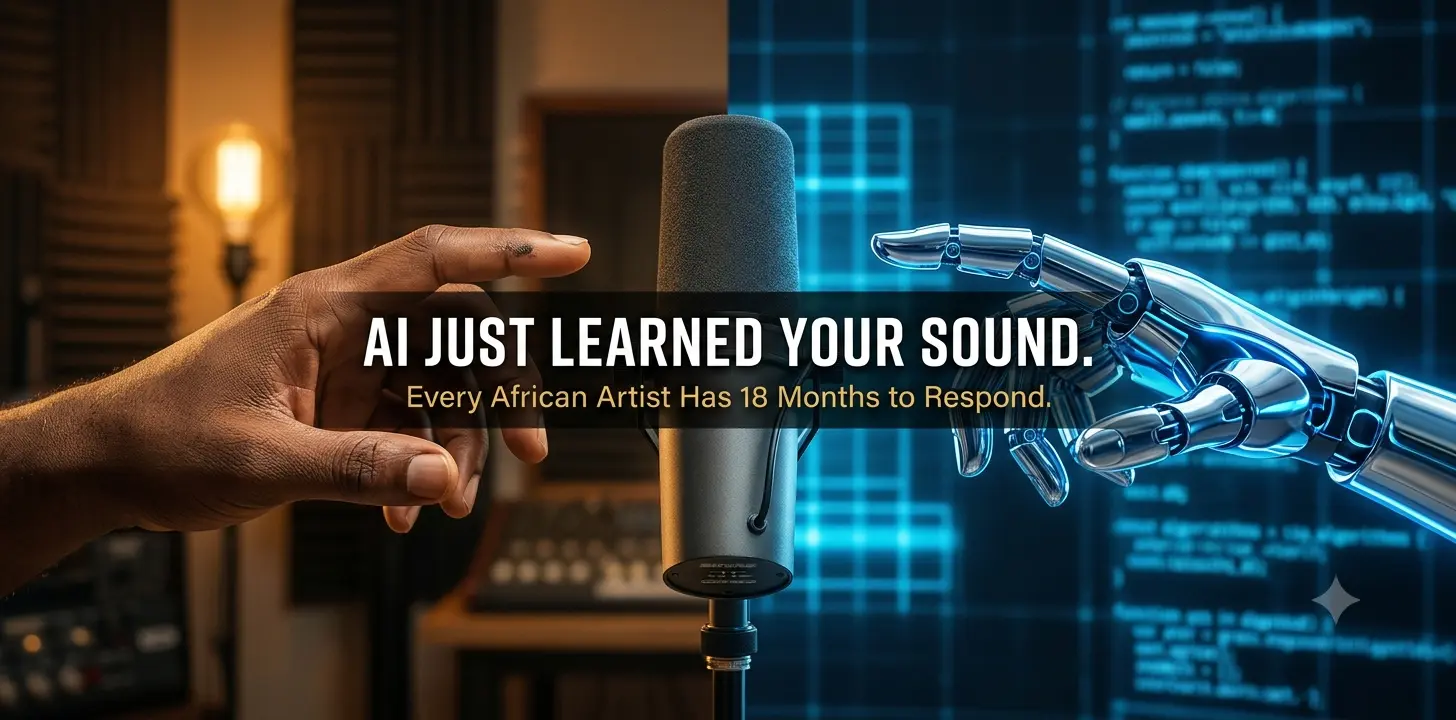
Type a prompt. Press generate. Wait eleven seconds.
What comes back is a three-minute Afrobeats instrumental with a proper mix, a clean low end, a convincing guitar melody, and a tempo that sits exactly in the range that makes an East African body want to move.
It is not great. But it is not embarrassing either. And it cost nothing and took eleven seconds.
This is not a hypothetical scenario from a technology conference. This is what any African artist can do right now on a Tuesday afternoon using tools that did not exist in usable form eighteen months ago. The question that is splitting the African music creative community in 2026 is not whether this is happening. It is what it means, who it threatens, and what the artists who refuse to be replaced are going to do about it.
Making up fifty percent of the region's population, many young West Africans have passively accepted the rise of AI-generated music, but others worry deeply about its impact on creativity and the future of African music. OkayAfrica
Passively accepted. That phrase is doing serious work. It does not say embraced. It does not say rejected. It says passively accepted, which is the most dangerous of all possible positions because it describes a generation that is watching something happen to their cultural identity without making a deliberate decision about how to respond to it.
This post is about making that decision deliberately. Before the eighteen months run out.
What AI Music Can Actually Do in 2026
The honest conversation starts with an accurate picture of where the technology actually is, not where the most alarmed voices claim it is and not where the most dismissive voices claim it isn't.
AI music generation tools in 2026 can produce technically competent instrumentals in almost any African genre on demand. Amapiano log drum patterns. Afrobeats percussion stacks. Bongo Flava melodic structures. Urbantone rhythmic frameworks. The genre vocabulary of African music has been ingested by these models thoroughly enough that a generated beat can pass a casual listen without triggering immediate suspicion.
What the tools cannot do is feel. They cannot produce the specific weight of a Dar es Salaam producer's groove, built from twenty years of hearing how a particular community responds to a particular rhythmic placement. They cannot replicate the emotional intelligence of a Nairobi beatmaker who understands that the bass needs to sit differently in a song about loss than in a song about a road trip. They cannot make the micro-decisions that experienced human producers make instinctively because those decisions are not in the training data. They are in the body, in the street, in the lived experience of being inside the culture rather than analyzing it from the outside.
That gap, between technical competence and genuine cultural intelligence, is real and currently significant.
The question is how long it stays significant.
The African Music Community Is Not Agreed on the Answer
The conversation inside African music about AI-generated music is splitting along lines that do not map neatly onto age, genre, or geography. Some artists see it as a democratizing tool that gives artists without access to expensive producers a professional starting point. Others see it as an existential threat to the livelihoods of the producers, beatmakers, and session musicians who form the invisible backbone of the industry. OkayAfrica
Both positions contain truth and neither contains the whole picture.
The democratization argument is real. An upcoming artist in Kisumu or Kumasi or Kinshasa who cannot afford a professional producer and cannot access a professional studio is currently navigating a genuine infrastructure gap. If an AI tool closes that gap and gets their vocal onto something that sounds professional enough to attract playlist attention, something positive has happened for that specific artist in that specific moment.
The existential threat argument is also real. The Kenyan beatmaker who has spent fifteen years developing a sound that is specifically and recognizably theirs, who sells beat licences to artists across East Africa, who charges what their craft is worth because their craft is genuinely worth it, is competing in 2026 with a tool that generates infinite variations of their genre for free in eleven seconds. That is not a theoretical threat. It is already affecting how beats are priced and how producers are valued.
The artists and producers who are navigating this most effectively are the ones who have stopped arguing about which position is correct and started asking a sharper question: what does AI music make more valuable, not less?
What AI Cannot Commoditize
Here is the counter-intuitive truth that the most forward-thinking African artists have arrived at.
AI flooding the market with technically competent but culturally hollow instrumentals does not make great beats worthless. It makes them more valuable. It raises the floor of what counts as acceptable production quality while simultaneously raising the premium on production that carries genuine cultural intelligence and human creative identity.
Think about what happened to photography when digital cameras became cheap and accessible. The prediction was that professional photographers would be replaced. The reality was that technically competent photography became abundant and worthless while photography with genuine artistic vision became more sought-after and more expensive than before. The middle market collapsed. The top of the market grew.
African music is entering the same dynamic in 2026.
An AI-generated Afrobeats instrumental can reach technical adequacy in eleven seconds. It cannot reach the specific groove that a Lagos producer built by growing up on a particular street, absorbing a particular community's relationship to rhythm, and spending years developing the instinct to know when a snare needs to land two milliseconds later than the grid suggests. That knowledge is not in the training data. It is in the person.
The artists who will be hurt most by AI music are not the ones at the top of the craft. They are the ones who were producing technically adequate but culturally thin work and charging for it on the basis that there was no cheaper alternative. That alternative now exists. The market has moved.
The Licence Problem That Nobody Is Talking About
There is a practical and currently unresolved problem with AI-generated music that every African artist needs to understand before deciding how to incorporate it into their workflow.
The copyright status of AI-generated music in most African jurisdictions is unresolved. Kenya's copyright framework, Tanzania's copyright framework, Nigeria's, Ghana's, South Africa's, none of them have produced definitive guidance on whether an AI-generated instrumental can be owned, licensed, or registered by the person who prompted it. The legal position is genuinely unclear and in some cases has been tested in court with contradictory results.
This matters enormously for an artist building a catalogue intended to generate royalties, attract sync placements, or be audited by a label during due diligence. A catalogue built partly on AI-generated instrumentals with unclear ownership status is a catalogue with a legal vulnerability sitting inside it that will surface at the worst possible moment.
The MCSK crisis showed Kenya's music community what happens when institutional systems fail and documentation does not exist. An artist whose catalogue contains AI-generated music with no clear licence chain is building a smaller version of the same problem into every record they release.
A properly licensed beat from a human producer carries documentation. It carries a clear chain of creative ownership. It carries a licence agreement that specifies every permitted use. That documentation is what makes the catalogue solid enough to survive an audit, a dispute, or a label's legal team asking questions.
In 2026 that distinction, between a properly licensed human-produced beat and an AI-generated instrumental with unclear copyright status, is not a philosophical preference. It is a legal and financial protection that determines whether the music you make tonight will still be cleanly yours in three years.
What the Artists Who Are Winning Are Doing
Karun opened Embe Studio in Nairobi specifically to build the kind of creative space she wished had existed when she was starting out, a place where the infrastructure matches the ambition of the artists using it, where the production is built on a foundation solid enough to support everything built on top of it. OkayAfrica
That decision reflects something that the most successful African artists building in 2026 share regardless of genre or geography. They are investing in the foundation because they understand that the foundation is what survives every wave of disruption, including this one.
AI music is a disruption. It is real, it is accelerating, and it is going to reshape parts of the music industry that have been operating the same way for decades. The artists who treat it as an excuse to lower their standards, to release faster on cheaper production with less documentation, will find that the disruption has been used against them.
The artists who treat it as a signal to raise their standards, to build more carefully, to ensure that everything they release is built on production that carries genuine cultural intelligence and proper documentation, will find that the disruption has created space at exactly the level they are building toward.
The Foundation Is Still the Same
At mBeatz, every beat in the catalogue is produced by human producers with roots in the East African and broader African sound, carrying the cultural intelligence that eleven seconds and a text prompt cannot replicate. Every beat comes with instant WAV delivery and a full licence document, providing the documentation chain that AI-generated music cannot currently offer.
In a market being flooded with technically adequate but legally ambiguous AI production, a properly licensed beat from a producer with genuine cultural roots in the African music tradition is not a more expensive option. It is a more protected one.
The artists who understood this in 2024 are releasing clean catalogues in 2026. The artists who understand it today are the ones whose catalogues will be clean in 2028 when the AI music conversation has matured and the legal frameworks have caught up.
Whether you are building in Nairobi or Lagos, in Accra or Johannesburg, in Kigali or anywhere else on this continent, pay with MPesa, Airtel Money, Visa, Mastercard, Apple Pay, PesaPal, or bank transfer and get a beat that comes with a clear owner, a clear licence, and a clear paper trail.
Browse the mBeatz catalogue at mbeatz.org and build on something that is genuinely and completely yours.
Where do you stand on AI music as an African artist or producer? Tell us honestly in the comments. This is a conversation the industry needs to have out loud.
.jfif)
0 Comments
Leave a Comment