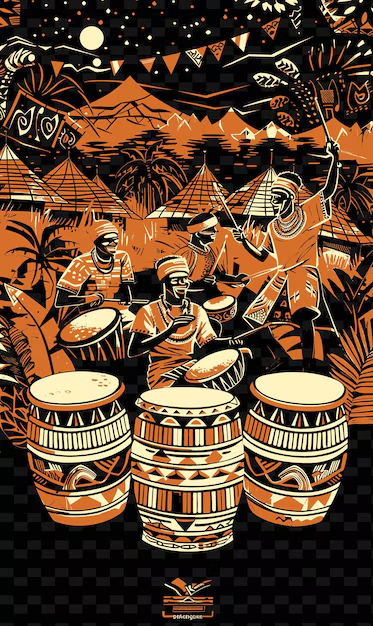
Before there was a studio, there was a drum.
Before there was a DAW, there was a kora. Before there was an 808, there was a talking drum carrying messages across distances that no other communication technology could bridge. Before Afrobeats had a Billboard chart position, before Amapiano had a Grammy category, before TikTok existed to make a viral African song reach forty million people overnight, there was a continent making music with more rhythmic sophistication, more tonal complexity, and more communal intelligence than anywhere else on earth.
That tradition did not disappear when the recording studio arrived. It moved inside it. Every Afrobeats production carrying a West African percussion stack, every Bongo Flava instrumental built on Taarab melodic tradition, every Amapiano record where the log drum creates that specific hypnotic pull that no synthesizer outside South African house music has ever replicated, is the direct continuation of a musical lineage that begins in instruments carved from wood and hide and gourd long before anyone thought to plug anything into electricity.
Understanding where the sound came from makes the sound you build today more powerful. Not as an academic exercise. As a creative foundation.
The Instruments That Built Everything You Are Hearing Now
The kora is where the conversation about African instrumental music has to begin because nothing else in the world sounds like it and because its influence on the melodic sensibility of West African popular music, including Afrobeats, is deeper than most producers who have never studied it would recognise.
A 21-string bridge harp built from a large calabash gourd, the kora is native to the Mande people of West Africa and has been played by griots, the hereditary musician-historians of the region, for centuries. Its tuning produces a specific harmonic relationship between strings that creates the warm, shimmering melodic quality that shows up, transformed and updated but recognisably descended, in the keyboard and guitar arrangements that sit over Afrobeats productions in 2026.
Burna Boy's melodies carry kora DNA. Wizkid's harmonic approach carries it. When you hear an Afrobeats record and feel that specific warmth in the melodic arrangement, the feeling that the music is smiling at you before it has said anything, you are hearing an instrument that West African music has been refining for centuries, filtered through contemporary production tools.
The talking drum, known as the dundun in Yoruba tradition, is the instrument most directly ancestral to the rhythmic complexity that makes Afrobeats grooves physically irresistible. A pressure drum played under the arm, the talking drum can be squeezed to alter pitch mid-beat, allowing a skilled player to replicate the tonal contours of Yoruba speech. It communicates. It tells stories through rhythm in a way that Western percussion traditions, built on unpitched rhythm, cannot approach.
The polyrhythmic percussion frameworks that a talking drum player builds, multiple rhythmic patterns layered simultaneously with each one maintaining its own internal logic while contributing to an overall groove, are the direct ancestors of the layered percussion stacks that define Afrobeats production. The snare sits in one rhythmic cycle. The hi-hat sits in another. The shaker sits in a third. Each one is doing something different and together they create the specific forward-moving complexity that makes it impossible to stand still.
The djembe, a rope-tuned skin-covered goblet drum from West Africa, has become the most globally recognised African percussion instrument, appearing in music education programmes, world music festivals, and studio sessions on every continent. Its three tones, bass, tone, and slap, give a single instrument the harmonic range that Western percussion rarely offers, and its community playing tradition, where multiple djembe players build interlocking rhythmic patterns together, is one of the clearest examples of the collective musical intelligence that African music has always operated by.
The mbira, also known as the thumb piano or kalimba, originates from Zimbabwe and Southern Africa and produces a shimmering, slightly metallic melodic tone by plucking metal tines of different lengths. The mbira's tuning is microtonal, sitting between the notes of the Western scale in ways that give it a specific emotional quality that synthesisers have tried and largely failed to replicate. Its influence is audible in the atmospheric melodic textures of Amapiano production and in the electronic music coming from Southern Africa's underground scenes in 2026.
The balafon, a West African xylophone built from wooden keys suspended over gourd resonators, produces a warm, woody melodic quality that sits beneath the brighter tones of the kora in traditional Mande ensemble music. Its harmonic series creates the specific chord relationships that give West African music its emotional directness, a quality that translates directly into the chord progressions of contemporary Afrobeats without most listeners or producers being aware of the lineage they are working within.
The oud, the unfretted lute that dominates North African and Arab musical tradition, is the instrument most responsible for the melodic sophistication of music across the northern half of the continent. Its twenty-three frets and eleven strings allow for the microtonal ornamentation that gives North African music its specific emotional expressiveness, and its influence can be heard in the melodic approach of Egyptian, Moroccan, Algerian, and Sudanese popular music in 2026.
What African Beats Are Called and Why the Naming Matters
The umbrella term that most English-language listeners reach for is Afrobeats, but that word covers a narrower territory than the full range of what African music is making in 2026.
Afrobeats, originating primarily from Nigeria and Ghana in the early 2000s, is the global commercial face of the broader African popular music movement. Built on West African percussion tradition fused with hip-hop, R&B, and dancehall influences, it is the genre that Burna Boy, Wizkid, Davido, Rema, and Ayra Starr have carried to Grammy nominations, FIFA World Cup halftime shows, and four billion Spotify streams on a single record.
Amapiano is South African, emerging from the townships of Johannesburg and Pretoria, built on the log drum bass synth pattern that creates its specific hypnotic groove. It is moving from cool club trend to essential global dance language in 2026, with its influence appearing in Afrobeats productions, R&B arrangements, and mainstream pop worldwide.
Bongo Flava is Tanzanian, fusing Western R&B and hip-hop with dancehall, Afrobeats, and traditional Taarab and Dansi, producing a romantic warmth that is specifically Swahili in its emotional register.
Gengetone is specifically and defiantly Nairobi, a fusion of Afrobeats, hip-hop, and Swahili slang culture that could only have emerged from a specific generation of young Kenyans processing urban life through music.
Afro-house, azonto, Kizomba, Kuduro, Coupe-Decale, Highlife, Jùjú, Fuji, Makossa. Every African country and every African region has its own named popular music tradition and most of them have been building for longer than Afrobeats has existed as a commercial category.
The names matter because the names carry the specific production DNA that makes each genre distinct. A Bongo Flava beat is not an Afrobeats beat with a different flag on it. A Gengetone instrumental is not an Afrobeats instrumental recorded in Nairobi. Each carries its own rhythmic logic, its own harmonic tradition, its own relationship between the bass and the percussion and the melodic arrangement.
When an artist finds the right genre name for the sound they are chasing and then finds a beat that actually carries that genre's DNA rather than an approximation of it, the difference is audible from the first bar.
The Viral African Song and What It Is Actually Telling You
Every few months a new African record goes viral in a way that crosses from the African music community into the broader global TikTok and Instagram ecosystem and introduces millions of new listeners to the genre.
The pattern is consistent and instructive. The record carries a groove that is specific enough to feel distinct and universal enough to feel immediately accessible. The dance that emerges from it, whether it is a specific choreography the artist introduced or an organic movement that listeners discovered independently, travels faster than the music itself across social platforms. The song gets recreated, remixed, covered, and sampled by creators on every continent within days of going viral.
What makes an African song go viral in 2026 is not a formula. But the records that do it consistently share certain qualities. The hook arrives quickly. The groove is specific enough to be identifiable from the first few seconds. The vocal delivery has a conversational warmth that makes the listener feel they are being addressed personally rather than broadcast at. And the production sits in a sonic register that translates cleanly through phone speakers, which is the primary listening environment of the TikTok and Instagram discovery ecosystem.
Rema's "Calm Down" was the record that demonstrated what scale looks like when an African song goes fully viral in the current era, crossing one billion streams and entering markets that Afrobeats had never previously penetrated at that depth. What followed was not just a viral moment but a structural shift in how global playlist curators think about African music as a discovery category.
The viral African song is never just entertainment. It is always also an announcement that the audience for African music has just expanded again and that every artist building in the genre is operating in a larger market than they were the previous month.
Free Beats, Cheap Instrumentals, and the Honest Conversation Every Artist Needs
The search for free African instrumentals and cheap beats in Africa is one of the most common starting points for artists across the continent and in the African diaspora globally.
The desire is completely legitimate. An upcoming artist in Kampala or Kumasi or Kigali who is building their first recordings does not have an unlimited budget for production. Finding affordable instrumentals is not laziness or a lack of seriousness. It is the practical reality of building a music career without the infrastructure of a label budget behind you.
The honest conversation is about understanding what free actually costs in the long run, and where affordable does not mean compromised.
A free beat downloaded from YouTube carries no licence documentation. The producer retains all rights and can change their terms at any time, remove the video, register the beat for Content ID, or sell an exclusive licence to another artist, all of which can result in your released music being claimed, muted, or taken down without warning. The free beat costs nothing upfront and potentially costs everything downstream.
A cheap instrumental with a proper licence costs something upfront, usually between ten and thirty dollars at a basic tier, and comes with documentation that protects everything you build on top of it permanently. The cheap instrumental with proper documentation is not the compromise option. It is the professional option at the accessible price point.
mBeatz offers something that bridges this gap in a way that serves artists at every stage. Subscribing to the mBeatz newsletter gives you access to a free beat, a properly produced African instrumental that arrives as a genuine gift from the platform to the community it was built to serve. The free beat section of the website exists as a standing resource for artists who need to start building before their budget allows for licensed purchases.
These are not demo files or tagged watermarked previews. They are genuine beats, made with the same production quality as the paid catalogue, offered freely because mBeatz understands that the artist who starts on the platform with a free beat and builds something real is the artist who comes back when they are ready to invest in a proper licence for their serious release.
Browse the full mBeatz beats catalogue at mbeatz.org/beats and check the free beat options while you are there. The newsletter subscription that unlocks the free beat takes thirty seconds and connects you to a platform that was built specifically for African artists rather than adapted for them as an afterthought.
The Platforms That Sell Budget-Friendly African Instrumentals and What to Look For
The market for affordable African instrumentals in 2026 is wider than it has ever been. The questions to ask before purchasing from any platform are consistent regardless of price point.
Does the purchase include a written licence document specifying permitted uses? Does the file delivered match the quality level described at purchase, WAV where WAV was promised, untagged where untagged was promised? Is the producer's identity and catalogue available for review so you can evaluate their genuine engagement with the African musical tradition? Does the platform offer payment methods that work for your specific location without requiring workarounds?
mBeatz answers all four questions affirmatively and adds something that most budget-friendly beat platforms do not: cultural authenticity. The catalogue is built by producers rooted in East African and broader African musical traditions, making instrumentals that carry the genre's DNA from the inside rather than approximating it from the outside.
Every purchase completes through MPesa, Airtel Money, Visa, Mastercard, Apple Pay, PesaPal, or bank transfer. Instant WAV delivery. Proper licence included regardless of the price tier. The most affordable option on the platform comes with the same documentation infrastructure as the most expensive.
Because the music you make on a ten dollar licence deserves to be protected as completely as the music you make on a hundred dollar exclusive.
What African instrument would you most want to hear sampled in a contemporary Afrobeats production? Drop it in the comments.
.jfif)

0 Comments
Leave a Comment