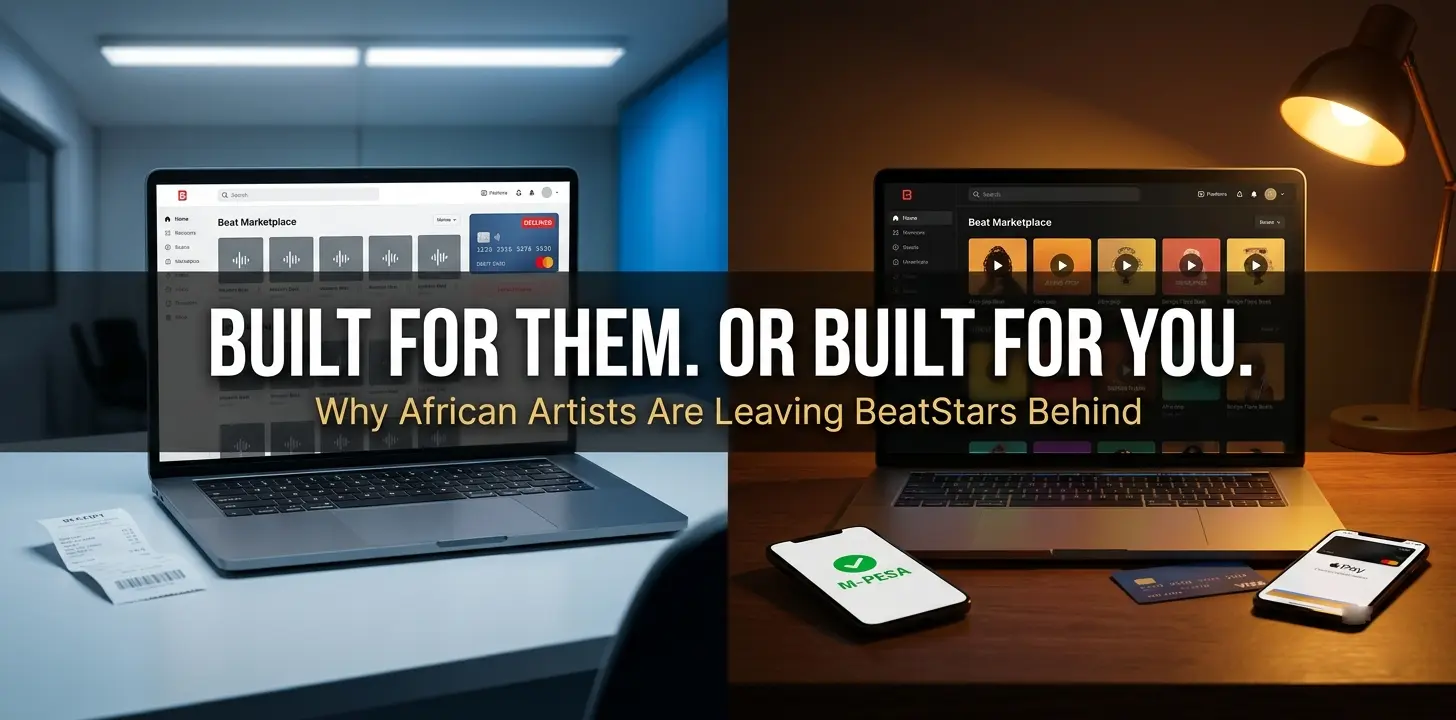
You have heard of BeatStars.
Every artist who has spent more than twenty minutes researching how to buy beats online in 2026 has landed on BeatStars, scrolled through three million producers, listened to forty beats that all sound vaguely similar, attempted to pay with a Kenyan debit card, and closed the tab.
This post is for everyone who has been through that experience and wants a direct answer to the question nobody in the beat marketplace industry has bothered to answer for African artists specifically.
Which platform actually works for you, where you are, with the payment method you have, for the sound you are trying to make?
The answer is not BeatStars. It is not Airbit. It is not Traktrain. Here is exactly why, and what exists instead.
What BeatStars Actually Is and Why It Falls Short for African Artists
BeatStars, Airbit and Traktrain are classic beat marketplaces built around per-beat licensing. You upload beats, set up non-exclusive leases and exclusive rights, choose your prices and earn when an artist buys a license. Luke Mounthill Beats
BeatStars is the largest beat marketplace on the planet by volume. Three million producers. Millions of beats. Every genre imaginable represented in some form.
That scale is also its fundamental problem for an African artist looking for a specific sound.
BeatStars remains a functional platform with the largest selection of beats available online. However, the massive scale creates quality control challenges and overwhelming choice for serious artists. Slime Green Beats
Overwhelming choice from producers who are predominantly based in the United States, Europe, and Latin America, making beats for audiences in those markets, filtered through the sonic sensibilities of those cultures.
When an artist in Nairobi searches BeatStars for an Afro-pop beat, what they receive is a collection of instrumentals made by producers in Atlanta or Berlin who heard Afrobeats on a playlist and approximated what they thought it sounded like. The groove is close but not quite right. The bass sits differently. The melodic choices reference the genre without fully inhabiting it. The result is a beat that sounds like African music from the outside rather than African music from the inside.
That distinction is everything. The African sound carries cultural intelligence that cannot be replicated by producers who learned it from Spotify playlists. The specific weight of a Bongo Flava groove, the precise melodic sensibility of Kenyan Afro-pop, the rhythmic framework of Gengetone, these are not genre tags. They are lived experiences translated into production decisions by people who grew up inside the culture they are building from.
BeatStars does not have enough of those producers. And the ones it does have are buried under three million others.
Then there is the payment problem.
BeatStars processes payments through PayPal, Stripe, and major international card networks. For an artist in Kenya whose bank has not enabled international transactions on their debit card, for an artist in Tanzania who primarily uses MPesa, for an artist anywhere in East or Central Africa whose most accessible payment method is a mobile money wallet, BeatStars is functionally inaccessible regardless of how many beats it contains.
A marketplace with three million beats that you cannot pay for is not a marketplace. It is a catalogue of things you cannot have.
What Airbit Is and Where It Fails the African Market
Airbit focuses on ease of licensing and selling beats directly, with customizable stores and automated delivery. It offers a limited free tier and no direct stem uploads for free users. SoundClick
Airbit is BeatStars' most direct competitor and in several technical respects it is the more polished product. Since its acquisition by BandLab, Airbit eliminated marketplace commission fees, which translates to more competitive pricing for buyers. The HTML5 player ensures smooth streaming. The contract generation is instant.
For an artist in the United States or the United Kingdom, Airbit is a legitimate and well-functioning option.
For an African artist, the same payment barrier applies. Airbit supports various payment methods, all of them designed for Western banking infrastructure. MPesa is not among them. Airtel Money is not among them. PesaPal is not among them.
Airbit's marketplace is smaller than BeatStars and does not solve the reach problem. The revenue structure is identical to Traktrain, just with better storefront tools. SoundClick
And critically, Airbit's producer base carries the same geographic and cultural bias as BeatStars. The beats on Airbit are predominantly made by producers in markets where hip-hop, trap, R&B, and pop are the dominant sonic references. An East African artist looking for production that understands the specific rhythmic and melodic language of their region is searching in the wrong catalogue.
What Traktrain Is and Why It Is Not Your Platform
Traktrain appeals visually with its curated aesthetic and focus on trap and hip-hop producers. Beatpass
Traktrain is the boutique option. Smaller than BeatStars and Airbit, more selective about its producers, designed around a specific aesthetic that leans heavily toward American trap, underground hip-hop, and the production styles that dominate those scenes.
Traktrain has a bit of a different vibe. They are more about quality over quantity, kind of like a boutique shop compared to a giant department store. They have a more curated feel, which can attract artists looking for something a little more unique or underground.
If you are making trap music for a Western audience and your sonic references are entirely within that tradition, Traktrain is a coherent choice. It is built for you.
If you are making Afro-pop in Nairobi, Bongo Flava in Dar es Salaam, Afrobeats in Lagos, Amapiano-influenced production in Johannesburg, or any of the dozens of sounds that define African music in 2026, Traktrain is a platform that has nothing to do with you. Its curation is excellent within its niche. Its niche is simply not yours.
The Problem None of Them Have Solved
The three largest beat marketplaces in the world share a structural problem that none of them have addressed because none of them were built with African artists in mind.
The problem is threefold.
First, the sound. Afro-pop, Bongo Flava, Gengetone, Afrobeats, Amapiano, Afro-house, and the dozens of regional African sounds that are driving the continent's music industry to fifteen percent annual growth are underrepresented in every major Western beat marketplace. The beats that claim these genre labels are often approximations made by producers who understand the genre intellectually but not culturally.
Second, the payment. Mobile money is how East and Central Africa moves money. MPesa alone serves over fifty million active users across seven countries. Airtel Money extends across seventeen African countries. None of the major Western beat marketplaces have built payment infrastructure around these systems because their primary markets have never needed them to. The result is that the fastest-growing music market in the world is also the market with the least access to the beat marketplace infrastructure that professional music production requires.
Third, the currency and pricing. Beats on BeatStars and Airbit are priced in US dollars for markets where US dollar incomes are normal. For an artist in Kenya earning in Kenyan shillings, in Tanzania earning in Tanzanian shillings, in Nigeria earning in naira, the pricing architecture of Western beat marketplaces creates an additional friction that compounds the payment access problem.
What mBeatz Is and Why It Exists
mBeatz is a Kenyan-built beat marketplace that exists specifically because every problem described above needed an African solution.
The sound is right. Every beat in the mBeatz catalogue is produced by producers rooted in the East African and broader African musical tradition. Afro-pop built by producers who grew up listening to and making Afro-pop. Bongo Flava instrumentals carrying the specific melodic warmth that the Tanzanian musical tradition has been refining for decades. Afrobeats-influenced production that understands the difference between approximating the genre from the outside and building it from the inside. Afro-house beats with the four-to-the-floor architecture and African melodic identity that the genre requires. Gengetone instrumentals that could only have come from Nairobi because Gengetone could only have come from Nairobi.
The payment works for every African artist regardless of which country they are in or which payment system their banking infrastructure supports.
MPesa and MPesa Till for artists across the East African MPesa network in Kenya, Tanzania, and beyond. The most familiar and fastest payment method for millions of East African artists, completing a beat purchase in under four minutes from browsing to WAV file in inbox.
Airtel Money for artists across the seventeen African countries where Airtel operates, bringing the same mobile payment convenience to West, Central, and East African markets outside the MPesa network.
Visa and Mastercard from any African country with internationally enabled bank cards, and from any country in the world. The same card that works for everything else online works here without friction.
Apple Pay for any artist with an Apple device and a linked card, in Kenya, in Nigeria, in South Africa, in the United Kingdom, in the United States, in Canada, in Australia, anywhere on earth where Apple Pay is supported.
PesaPal for artists in Kenya and East Africa who prefer a trusted regional payment gateway that aggregates multiple local payment options.
Bank transfer for artists who prefer traditional banking infrastructure and are comfortable with the one to three business day processing window that comes with it.
Every purchase delivers an instant untagged WAV file at professional recording quality and a proper PDF licence document specifying every permitted use, every platform, every stream limit, and every right that the artist holds from the moment the transaction clears.
That combination, the right sound, the right payment, and proper documentation, is what BeatStars, Airbit, and Traktrain have never offered African artists because African artists were never the audience those platforms were designed to serve.
The Comparison That Settles It
Here is the direct comparison every African artist deserves to see before they open BeatStars for the fourth time and wonder why nothing feels right:
| What You Need | BeatStars | Airbit | Traktrain | mBeatz |
|---|---|---|---|---|
| Afro-pop beats built from inside the culture | Approximations | Approximations | None | Built for it |
| Bongo Flava instrumentals | Rare | Rare | None | Core catalogue |
| MPesa payment | No | No | No | Yes |
| Airtel Money payment | No | No | No | Yes |
| Apple Pay | Yes | Yes | No | Yes |
| Visa and Mastercard | Yes | Yes | Yes | Yes |
| PesaPal | No | No | No | Yes |
| Bank transfer | No | No | No | Yes |
| Instant WAV delivery | Yes | Yes | Yes | Yes |
| Proper licence document | Yes | Yes | Yes | Yes |
| Priced for African markets | No | No | No | Yes |
The table makes the answer obvious. But the table is not the most important part of this comparison.
The most important part is the sound. You can solve payment friction with a borrowed credit card or a diaspora friend's PayPal. You cannot solve cultural inauthenticity in a beat. When the groove is wrong, the vocal fights it from the first take and nothing in post-production fixes that fundamental mismatch.
The beats in the mBeatz catalogue are right because they were made by people who understand what right means in the context of the music you are trying to make.
The African Beat Marketplace Built for This Moment
African music is posting fifteen percent annual revenue growth. Burna Boy just performed at the FIFA World Cup halftime show. Tyla won the Grammy for Best African Music Performance. Tems has five hundred million streams on a single record. The global audience for African music is the fastest growing in the recorded music industry.
The artists who are going to define the next chapter of that growth are not going to be found on BeatStars wrestling with payment errors and approximated Afrobeats beats. They are going to be found building on production infrastructure that was built specifically for the sound they are making, with payment systems that match how they actually move money, and with documentation that ensures everything they build is completely theirs.
That infrastructure exists. It is built in Kenya. It serves artists from Cairo to Cape Town and from the continent to the diaspora in London, Toronto, Atlanta, and Sydney.
Browse the mBeatz catalogue at mbeatz.org and find the beat that BeatStars, Airbit, and Traktrain could not give you.
Which beat marketplace have you tried as an African artist and what was your experience? Tell us in the comments. We read every one and we built mBeatz on exactly the feedback this question produces.
.jfif)
0 Comments
Leave a Comment