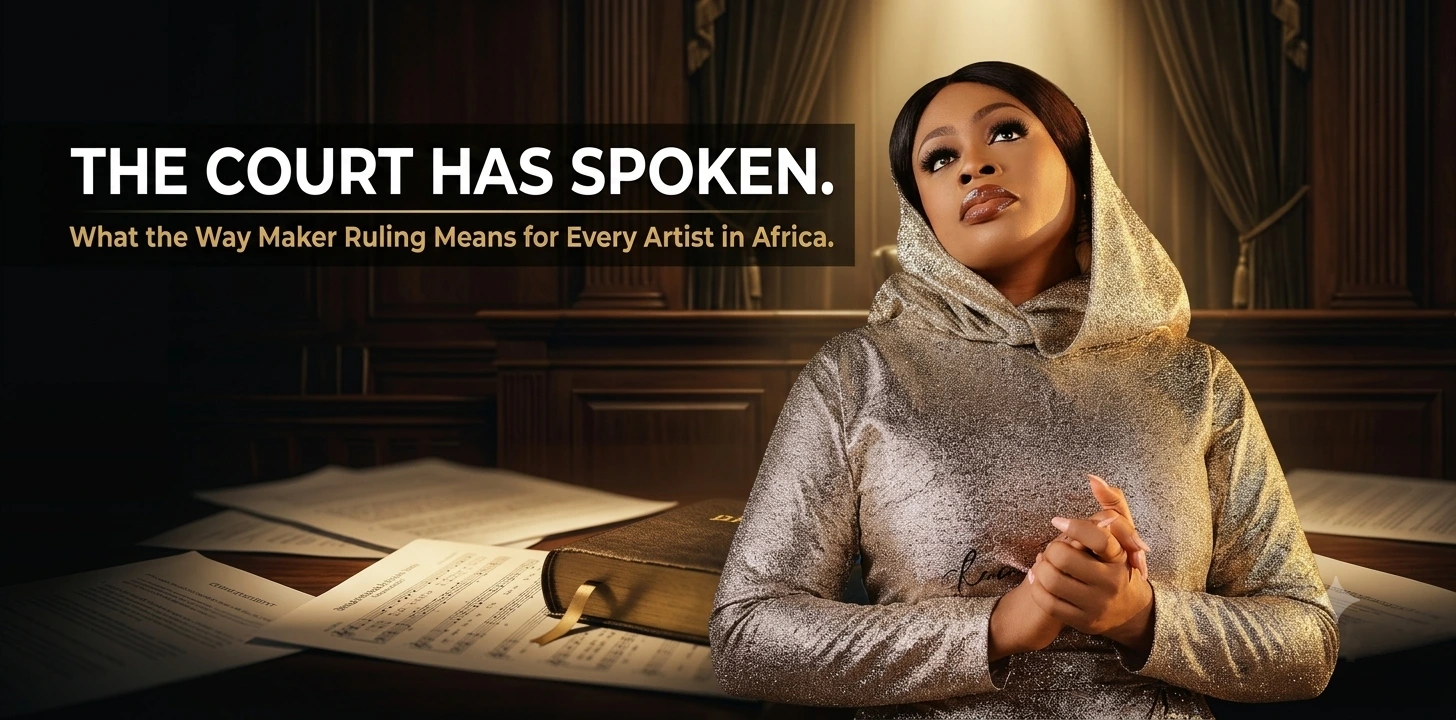
The number that started this story is N5 billion.
Five billion naira. The amount a music producer named Michael Oluwole, professionally known as Maye, claimed he was owed by one of the most celebrated gospel artists Africa has ever produced, for a song that has been sung in churches, arenas, and living rooms on every continent on earth.
The song was Way Maker. The artist was Sinach.
On July 24 2026, Justice A. Lewis-Allagoa of the Federal High Court in Lagos dismissed the lawsuit in its entirety, declared Sinach the sole author and copyright owner of Way Maker, and rejected every claim Oluwole had made about co-authorship, co-ownership, and performer's rights. The Ghana Report
The case is over. Sinach won completely.
But the reason she won is where every gospel artist in Africa, from Lagos to Nairobi, from Accra to Johannesburg, needs to pay very close attention. Because the judge's reasoning did not just settle one dispute between two people. It established something that every musician working in gospel, in worship, in Christian music across the continent needs to understand clearly before they enter another studio session.
What Actually Happened, From the Beginning
Way Maker was released in 2016 and became a global phenomenon, earning Sinach international recognition as the first African artist to top the Billboard Christian Songwriter charts. The song won Song of the Year at the 2020 Gospel Music Association's Dove Awards and BMI Song of the Year in 2021. Gistlover
A gospel song written by a Nigerian woman became the most covered worship song on the planet. It has been recorded in hundreds of languages. It has been sung by Michael W. Smith, Leeland, and Mandisa. It has been performed in stadiums and in tiny rural churches simultaneously. It is one of the most remarkable examples of African creative work achieving genuine global penetration in the history of recorded music.
Oluwole filed his lawsuit in March 2024, seeking legal recognition as a co-author and co-owner of Way Maker, claiming his role as studio engineer responsible for mixing, recording, mastering and creating instrumental accompaniments entitled him to copyright and performer's rights. He alleged Sinach released Way Maker without his consent, and demanded a share of all revenues the song had generated alongside N5 billion in damages. Talk Talk Nigeria
The claim rested on a simple argument: I was in the room. I worked on the recording. I contributed technical skill. Therefore I own part of what came out.
It is an argument that many producers and engineers across Africa have believed, in varying degrees, to be true about their own work. The Way Maker ruling just told them exactly how much of that belief is legally supported.
The answer is: far less than most of them think.
What the Judge Actually Said
This is the part of the ruling that needs to be read slowly and carefully because it contains information that changes how every gospel artist and every producer in Africa should think about studio relationships.
Justice Lewis-Allagoa ruled that copyright ownership belongs to the person responsible for creating the original expressive elements of a work, including its melody, harmony, lyrics, and arrangement. The judge further clarified that technical contributions by producers, sound engineers, or studio technicians do not automatically confer authorship unless they make original creative contributions to the composition itself. Asaba Metro News
Read that again. Melody. Harmony. Lyrics. Arrangement. Those are the elements that copyright protects. Those are the things that make a song a song rather than a collection of sounds.
Mixing is not one of those things. Mastering is not one of those things. Recording engineering is not one of those things. These are skilled technical services. They can be excellent. They can significantly improve the finished product. But they do not, under Nigerian copyright law as clarified by this ruling, automatically grant the person who performed them any ownership of the underlying creative work.
The court found that Way Maker had already been written and publicly performed by Sinach before Oluwole was ever engaged to work on the recording, and that his services were contracted and paid for as technical work rather than as creative co-authorship. Asaba Metro News
The song existed before he touched it. He was hired to improve the technical quality of something that already existed. He was paid for that work. That is the full extent of what he was owed, and the court found he had received it.
The Second African Gospel Case That Went Almost Unnoticed
The Sinach ruling is the biggest gospel copyright story of 2026. But it is not the only one.
Six months earlier, on the other side of the continent, a Kenyan court delivered a ruling in a remarkably similar dispute that established almost exactly the same principle for Kenyan gospel music.
In 1990, Kenyan gospel singer Douglas Jiveti composed a song called Mambo Ya Ajabu while studying at Kenyatta University. He recorded and released it in 1992 and it became a significant gospel hit. Twenty-five years later, a podcaster named Florence Nashami Wangar sampled the song with minimal changes and released it without Jiveti's knowledge or consent, distributing it across YouTube, Mdundo, and other digital platforms. Bloomberg Law
In December 2025, a Milimani Commercial Magistrate's Court awarded Jiveti Sh3 million in general damages, ruling that the 1992 gospel hit had been sampled and re-released without his consent, and that this constituted clear copyright infringement regardless of how many years had passed since the original release. Bloomberg Law
Three million shillings. Awarded to a Kenyan gospel artist for a song he wrote in 1990, against someone who used it in 2017, in a judgment delivered in 2025.
The time that passes between the original creation and the infringement does not reduce the owner's rights. The fact that the infringer is not a major commercial artist but a podcaster does not reduce the owner's rights. The fact that the song is thirty years old does not reduce the owner's rights.
Copyright is not a temporary protection that expires with cultural relevance. It is a permanent ownership right that travels with the song regardless of who uses it, how they use it, or how much time has passed.
The Third Case: Fathermoh and the Label That Took Control
The gospel copyright conversation connects to a broader ownership crisis in Kenyan music that the Fathermoh case brought into sharp focus earlier this year.
Kenyan musician Moses Otieno Ojwang, professionally known as Fathermoh, filed a case at the Copyright Tribunal seeking more than Sh87 million in alleged unpaid royalties, accusing a Nairobi-based record label and its US affiliates of unlawful monetisation and copyright infringement. Fathermoh alleged that the label took control of his entire digital music catalogue and issued copyright strikes against his own music whenever he attempted to release new work independently. Wikipedia
This case is not gospel specific. But the underlying mechanism it exposes is identical to the risk every gospel artist faces when the documentation around their music is unclear.
When a producer, an engineer, or a label can credibly claim involvement in your creative work without a clear paper trail establishing exactly what their role was, what they were paid for, and what rights that payment did and did not transfer, the legal dispute that follows is expensive, damaging, and entirely avoidable.
Sinach won because the evidence showed the song existed before the producer was engaged. Jiveti won because he could document original creation and the infringer could not produce any licence. Fathermoh is fighting because a contract he signed in 2021 created ambiguity that a label is now exploiting.
Three cases. Three African countries. One lesson running through all of them.
What Gospel Music Gets Wrong About Copyright
The gospel music community across Africa has a specific and understandable relationship to the concept of ownership that makes these cases more complicated than they would be in secular music.
Many gospel artists feel genuine discomfort with claiming strong ownership of music they believe was given to them through divine inspiration. The language of creative ownership can feel at odds with the spiritual experience of receiving a song as a gift rather than constructing it as a product.
Research into gospel music and intellectual property across Africa has found that widespread copyright infringement in church music settings stems significantly from a lack of awareness and enforcement, with musicians' reliance on churches for performance opportunities creating an environment susceptible to exploitation. Wikipedia
The belief that gospel music belongs to God and therefore to everyone is spiritually generous and humanly exploitable in equal measure. The courts do not adjudicate spiritual ownership. They adjudicate legal ownership. And legal ownership of a gospel song belongs to the human being who created the melody, the harmony, the lyrics, and the arrangement, regardless of the inspiration behind them.
Sinach's ownership of Way Maker is not in conflict with the belief that the song was given to her as a spiritual gift. It is the legal structure that protects her ability to ensure the song continues to serve the purpose she believes it was given to her to serve, without being monetised against her will by someone who touched the recording after it already existed.
Protecting your gospel music legally is not an act of greed. It is an act of stewardship.
What Every African Gospel Artist Should Do Right Now
The Way Maker ruling, the Mambo Ya Ajabu ruling, and the Fathermoh case together provide a clear and urgent instruction for every gospel artist building a music ministry in Africa in 2026.
Document your creative process from the beginning. Record demos before you enter a professional studio so there is evidence that the song existed in your voice and your creative vision before any producer or engineer touched it. Date your recordings. Keep voice memos, WhatsApp voice notes, rough phone recordings, anything that establishes the timeline of a song's creation.
Understand clearly what you are paying a producer or engineer to do. Mixing is a technical service. Mastering is a technical service. Beat production is creative work that requires a separate and specific licence agreement that clearly states what the producer owns and what they are transferring to you. The Way Maker ruling turned on exactly this distinction.
Get everything in writing before the session begins. A written agreement between a gospel artist and a producer or engineer that clearly specifies the scope of their contribution, the payment for their services, and the explicit statement that their technical work does not confer ownership of the underlying composition, is the document that prevents a N5 billion lawsuit from ever being filed.
License your beats properly. This is where the foundation begins. A gospel artist who records over a properly licensed instrumental, purchased with a clear licence document that specifies exactly what both parties own, has the clearest possible starting position for every ownership conversation that follows.
At mBeatz, the gospel beats catalogue carries instrumentals built specifically for worship, contemporary gospel, and African Christian music across the East African and broader African sound. Every beat comes with a proper licence document that establishes clear ownership from the first note, for artists in Kenya, Nigeria, Ghana, South Africa, and every African country where gospel music is being made and where the courts are increasingly deciding that the artist who created it deserves to own it completely.
Pay with MPesa, Airtel Money, Visa, Mastercard, Apple Pay, PesaPal, or bank transfer. Instant WAV delivery. Instant licence documentation.
Browse the mBeatz gospel beats catalogue at mbeatz.org/beats/gospel and start building your ministry on a foundation that the courts will protect.
Has a copyright dispute ever affected your gospel music or your ministry? Tell us in the comments. This is a conversation the African church music community needs to have openly.
.jfif)
0 Comments
Leave a Comment