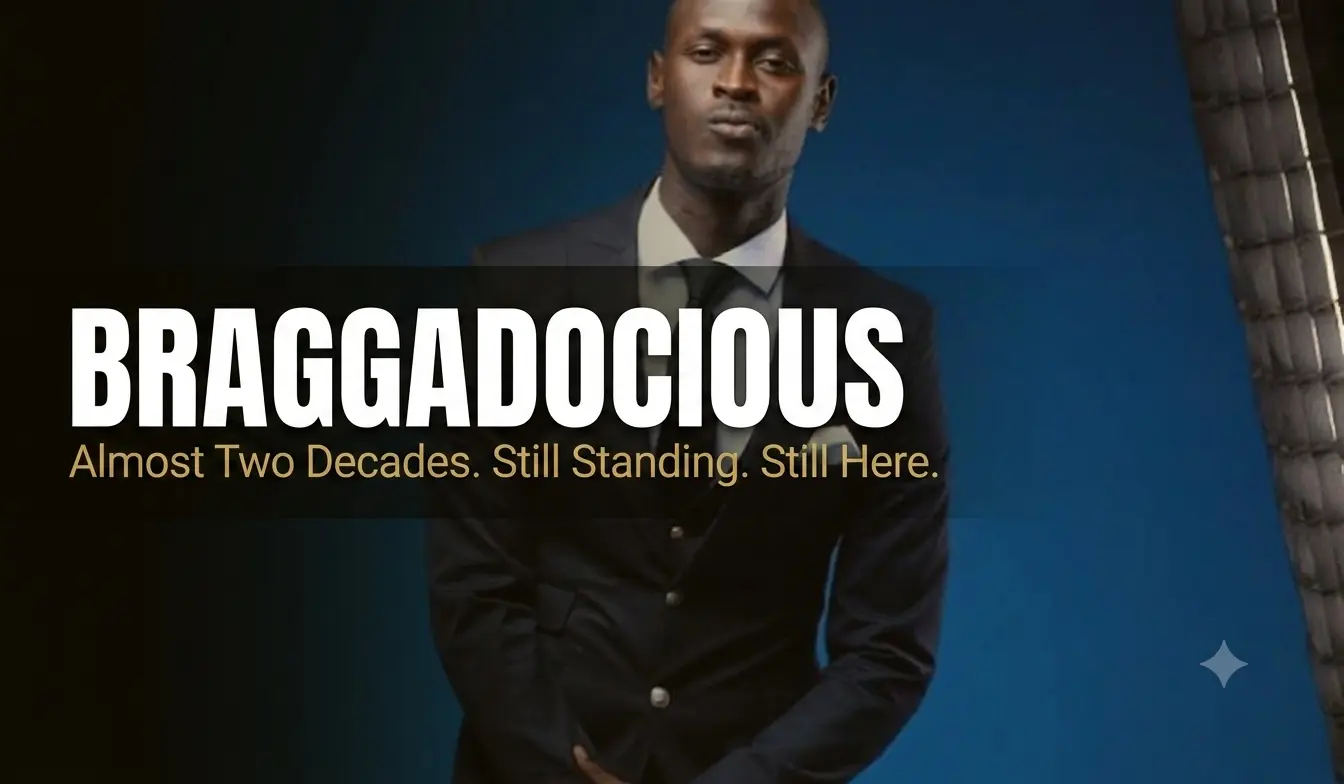
He could have called it anything.
A comeback record. A celebration record. A gratitude record. An artist with King Kaka's history had enough material for any of those angles and the audience would have received any of them warmly.
He called it "Braggadocious."
Not quietly. Not apologetically. Not wrapped in the kind of humility that Kenyan artists are often expected to perform when they have been through something. He walked back into the room after everything, looked directly at the camera, and announced himself with the most unapologetic word in the English dictionary.
Braggadocious for King Kaka is a celebration of his achievements and a statement of resilience and relevance in the industry over almost two decades. Rolling Stone
Almost two decades. The same number of years Mejja spent building before his debut album. The same kind of timeline that only makes sense when you understand that some careers are not built on momentum. They are built on refusal.
The refusal to quit when the industry moves on. The refusal to disappear when the body starts failing. The refusal to stay quiet when the government comes knocking.
King Kaka refused all three. Braggadocious is what that refusal sounds like when it finally has room to celebrate itself.
The Timeline That Makes the Title Make Sense
Kennedy Ombima was born December 29, 1987, in Kayole, Nairobi. He began rapping at fifteen, releasing his debut mixtape "Kaka King" in 2008 under the alias King Kaka.
That is the starting point. What follows is not a straight line upward. It is something more complicated and more instructive.
In 2019, two things happened to King Kaka within months of each other that would have ended most careers and most people.
The first was a song. "Wajinga Nyinyi" dropped in October 2019 and said, in clear, documented, rhyming Swahili, everything that Kenyans had been feeling about their political leadership for years. The track called out corruption, broken promises, and the complicity of citizens who kept returning the same people to power. It accumulated millions of views almost immediately and made King Kaka one of the most controversial figures in Kenyan public life overnight.
He was summoned by the Directorate of Criminal Investigations. He walked in, answered their questions, and walked back out. He did not retract the song. He did not apologise. He did not go quiet.
The second thing that happened in 2019 was that his body started failing.
King Kaka publicly revealed he was battling a severe illness in 2019, losing a significant amount of weight and facing what he later described as a near-death experience. The details he shared with his audience were visceral. This was not an artist managing a public health narrative carefully. This was a man telling his community that he had been genuinely close to not making it.
He made it.
What Almost Two Decades in Kenyan Hip-Hop Actually Looks Like
The temptation when writing about King Kaka is to let the cancer and the DCI story dominate everything, because both are dramatic enough to carry a narrative on their own.
But doing that misses what makes "Braggadocious" actually land the way it does in 2026.
The illness and the controversy are not the career. They are events inside a career that was already serious before either of them happened and continued to be serious after both of them passed.
King Kaka is the founder of Kaka Empire, a record label that has developed and released some of Kenya's most significant hip-hop voices. He has worked with artists across genres and generations. He showed up in the streets during the 2024 Gen Z protests when many in his position found reasons to remain neutral, posting support and using his platform directly at a moment when doing so carried visible risk.
He has not spent his career managing his legacy. He has spent it adding to it, one decision at a time, making choices that accumulated into something the word "Braggadocious" finally feels proportionate to.
Iyanii's contribution to the chorus blends effortlessly, giving the song a perfect flow that complements King Kaka's bars and highlights their journey in their music career that pays them well. Rolling Stone
That last phrase is the most underrated line in any description of this record. A music career that pays them well. Not "a career they are proud of." Not "a career that earned them respect." A career that pays them well. Two artists who chose to stay in Kenyan hip-hop, build inside it, refuse to compromise their way out of it toward safer commercial sounds, and arrived at a place where the music actually sustains them.
That is the brag. That is what "Braggadocious" is actually about.
Why This Record Hits Differently After the Gen Z Protests
One of the bittersweet things that have come out of the whole protest is how it has spiked a lot of creativity. SautiKing
The 2024 Gen Z uprising changed the temperature of Kenyan creative culture in ways that are still being measured. Artists who spoke were heard differently afterward. Artists who stayed silent were noticed differently too.
King Kaka spoke. He has been speaking since "Wajinga Nyinyi" in 2019, which means the Gen Z protest moment was not a first step for him. It was a continuation of a documented pattern. He is an artist who has consistently used his platform for something beyond his own commercial interests, and Kenyan audiences carry that history into every new release he drops.
When "Braggadocious" arrives in 2026 and announces that this is a man who is still here, still making the music, still winning, the audience that has watched the last seven years of his story hears that differently than they would hear it from an artist with no comparable record of showing up.
The brag earns its confidence from the behaviour that preceded it.
The Lesson Inside the Title
Every upcoming Kenyan artist who hears "Braggadocious" and feels something is receiving a very specific piece of information that is easy to miss inside the celebration of the music.
King Kaka did not earn the right to be braggadocious in 2026 by having a great 2026. He earned it by having a great 2008, and 2010, and 2013, and 2015, and by surviving 2019 twice, and by showing up in 2024 when the streets were burning and it would have been easier not to.
The record is the destination. Everything before it was the journey. And the journey was built one decision at a time, starting with the first track on the first mixtape in Kayole, over a beat that probably cost nothing and a recording setup that was almost certainly not professional.
The distance between that first record and "Braggadocious" is not talent. Talent was there from the beginning. The distance is choices. Consistent, deliberate, sometimes costly choices to keep building when the industry, the body, and the government each took a turn trying to convince him to stop.
That is what a career looks like when it is built correctly. Not fast. Not easily. Not without cost. But solidly enough that almost two decades later, the word "braggadocious" feels proportionate rather than arrogant.
Start Building the Record That Earns the Brag
The brag is never available at the beginning. It is only available to the artist who has done enough, consistently enough, for long enough that the audience understands exactly what the brag is referring to.
King Kaka started with a beat and a decision to take his music seriously from day one.
At mBeatz, every beat in the catalogue is built for the Kenyan and East African sound that King Kaka has spent twenty years helping define. Afro-pop, hip-hop, Genge-influenced, Afrobeats, and everything living between those genres in this city. Every beat comes with instant WAV delivery and a proper licence document so the first record you make is one you actually own completely.
The brag comes later. The beat comes first.
Find your sound at mBeatz and start building something worth bragging about.
What does King Kaka's journey mean to you as an artist still building in Kenya? Drop it in the comments.
.jfif)

.jfif)
0 Comments
Leave a Comment