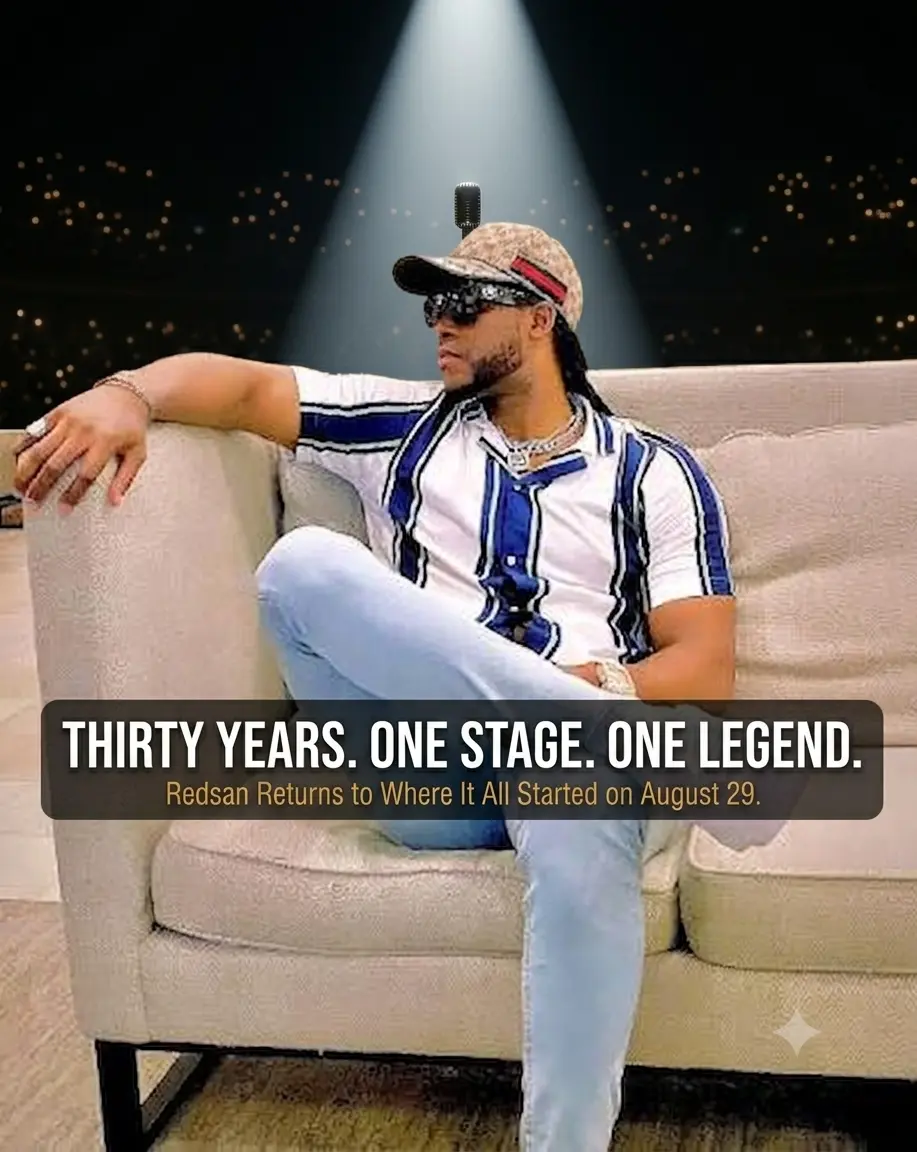
He was a teenager from Majengo when he walked into Carnivore for the first time with something to prove.
Swabri Mohammed was born on May 1, 1981, raised in the informal housing sector of Majengo in Nairobi, belonging to the Mijikenda tribe of Duruma from the coast of Kenya.
Majengo is not where the music industry looks for its next star. It is not where labels scout. It is not the neighbourhood that anyone in 1996 Nairobi would have pointed to and said: something global is going to come from there.
In 1998, Redsan won the Star Search talent competition held at the Carnivore in Nairobi. That victory marked the beginning of what would become one of the longest and most consequential careers in East African music history.
He won. He walked out of Carnivore with a different name, a different trajectory, and the beginning of something that three decades later still has not finished building.
On August 29, 2026, Swabri Mohammed is going back to Carnivore.
Kenya's undisputed king of dancehall, Redsan, will celebrate 30 years of musical dominance at the iconic Carnivore Grounds in Nairobi in a once-in-a-generation live experience. Redsan at 30 is not just a concert. It is a cultural milestone.
The same venue. Thirty years later. The boy from Majengo returning as the king of the genre he helped build in East Africa.
That is not a career. That is a statement about what is possible when an artist refuses to let the neighbourhood they came from define the ceiling of where they are going.
What He Built Between That First Night and This One
Redsan released his first album Seasons of the San in 2002 under Ogopa Deejays. The album included hit songs Julie and Wanipa Raha which propelled him to immediate fame across Kenya and East Africa. His second album Red followed in 2004 and his third album Pioneer in 2006, both significant commercial successes.
Three albums in four years. Each one building on the last. Each one extending the reach of a sound that was specifically and defiantly East African while drawing from the Jamaican dancehall tradition that had been shaping youth music globally since the 1980s.
What Redsan understood from the very beginning was something that the most successful East African artists of 2026 are still operating by: the groove is universal but the identity is local, and the combination of both is what makes a sound travel.
His music blends reggae rhythms with Swahili-infused dancehall, a fusion that quickly rose to prominence in Kenya and earned him recognition on international stages across Africa, Europe, the United States, and the Middle East.
Swahili-infused dancehall. Not a copy of what was coming from Kingston. Not an approximation of what the international market expected African dancehall to sound like. Something that could only have come from coastal Kenya, from the rhythmic relationship between Swahili and reggae that exists nowhere else on earth in quite the same form.
That specificity is what made it global. It always is.
The Hits That Built the Kingdom
Ask anyone who grew up listening to Kenyan music in the 2000s to name a Redsan song and watch what happens. They do not search their memory. The song arrives before the question has finished landing.
Badder Than Most. Julie. No More. Shoulder Back. These are not just hit songs. They are staples of Kenyan music culture, records that have become part of the soundtrack of a generation's coming of age in Nairobi and across East Africa.
That is the standard against which longevity is actually measured. Not chart positions that age out of relevance. Not streaming numbers that accumulate and then plateau. The test of a career that genuinely lasted is whether the songs still carry the memory of the moment someone first heard them, years or decades after they were released.
A Kenyan in their thirties who hears Julie in 2026 does not hear an old song. They hear themselves at a specific age, in a specific place, feeling a specific thing. That is not nostalgia. That is impact that was built correctly enough to survive time.
Thirty Years in an Industry That Eats Artists
The music industry across Africa in 2026 is more accessible than it has ever been. Distribution is instant. Streaming is global. A teenager with a phone and the right beat can reach listeners on five continents before breakfast.
What has not changed is the industry's appetite. It discovers artists, extracts what it needs from them, and moves on to the next discovery before the previous one has had time to understand what happened. The careers that survive this cycle are not the most talented ones. They are the most deliberate ones.
Redsan's thirty-year milestone is particularly significant in an industry where longevity can be difficult to sustain. While many artists fade with changing trends, he has managed to remain relevant by continuously evolving his sound while staying true to his roots.
Evolving the sound while staying true to the roots. That sentence contains the entire instruction manual for a long career in music and it is harder to execute than it sounds.
Staying true to the roots means knowing what is irreducibly yours. For Redsan it is the Swahili-dancehall fusion. The coastal Kenyan identity. The Majengo hustle underneath the polished stage presence. These are not marketing decisions. They are the actual substance of what he makes and why it keeps finding audiences.
Evolving the sound means understanding that the audience grows up and so must the artist. The teenager who won Star Search in 1998 was making music for a Nairobi that no longer exists in quite the same form. The forty-five-year-old heading back to Carnivore on August 29 is making music for a Nairobi that has changed in ways nobody in 1996 could have predicted.
The artist who refused to evolve would have become a nostalgia act. The artist who refused to stay true to their roots would have become a stranger to the audience that made them. Redsan managed to be neither and that is why August 29 is a celebration rather than a farewell.
What Carnivore Means in This Story
The venue choice is not coincidental and deserves more attention than it has received in the coverage of this concert.
Redsan's music career began when he won the Star Search challenge hosted at Carnivore in Nairobi in 1998. He is returning to the same venue on August 29, 2026 to celebrate thirty years.
Carnivore is where the story started. It is where a boy from Majengo stood on a stage for the first time and proved to everyone in the room, and more importantly to himself, that the music inside him was worth hearing by people who had not grown up beside him.
Returning to that stage three decades later is not sentimentality. It is a deliberate act of narrative completion. It says: I started here. Everything that happened in between was built on what this room gave me. And the room deserved to be part of the ending of the chapter.
There is something deeply instructive about this for every upcoming artist in Kenya who has performed at a small venue, a school showcase, a church hall, a talent competition, and told themselves that the venue was just a stepping stone they would leave behind.
Every significant stage you perform on becomes part of your story. The small stages are not beneath the big ones. They are the foundation the big ones sit on. Redsan understands this clearly enough to physically return to where the foundation was poured.
The Lesson Every Kenyan Artist Should Take From August 29
This blog has covered the careers of artists who bet on themselves after nineteen years like Mejja. Artists who walked away from the biggest label in Kenya to own their music like Bensoul. Artists who built so long and so well that Sony came looking for them like Nyashinski.
Redsan is something else again.
Redsan is what happens when an artist from a neighbourhood that nobody expects anything from takes the only tool available, talent and determination, and builds something that thirty years later still commands the biggest stage in Nairobi.
He did not have the advantages that made other careers easier. Majengo is not Westlands. The dancehall genre is not the easiest commercial path in East African music. The music industry of the early 2000s in Kenya had far less infrastructure, far less distribution access, and far less global connectivity than the industry available to every upcoming artist reading this today.
He built anyway. He built with what existed. He built until what he built became undeniable.
The upcoming artist in Kenya in 2026 has tools that Redsan did not have in 1998. Instant global distribution. Streaming platforms that algorithmically surface quality regardless of where the artist lives. Payment systems that allow a fan in Sweden to buy a track from a producer in Kisumu without either of them ever needing to speak to each other.
The only question is whether the music being built on top of those tools is worth building. Whether it is specific enough to be identifiable. Whether it is real enough to survive the industry's appetite. Whether it is patient enough to still be here in thirty years.
Redsan answered that question by buying a ticket back to Carnivore.
Now it is your turn to answer it.
At mBeatz, the catalogue carries East African sounds built for artists who are playing the long game. Dancehall-influenced beats, Afro-pop, Bongo Flava, Afro-R&B, and every genre that has built lasting careers across this region over the last three decades. Every beat comes with instant WAV delivery and a proper licence document, so everything you build from today is completely and legally yours for every one of the thirty years ahead of you.
Pay with MPesa, Airtel Money, Visa, Mastercard, Apple Pay, PesaPal, or bank transfer from anywhere in Africa and beyond.
Browse the mBeatz catalogue at mbeatz.org and start building something that deserves a thirty-year anniversary.
Where were you the first time you heard a Redsan record? Drop it in the comments. And if you are going to Carnivore on August 29, tell us.
.jfif)

.jfif)
0 Comments
Leave a Comment