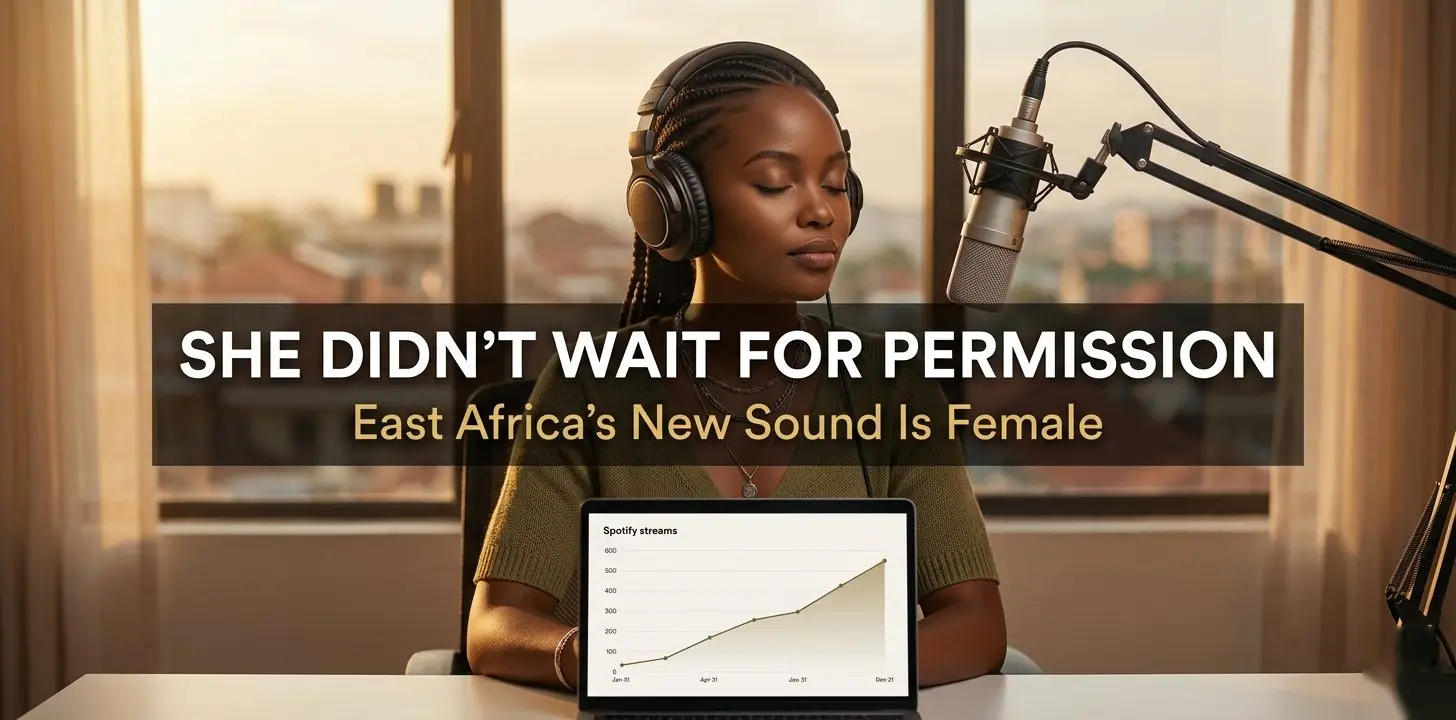
Nobody handed Njerae a blueprint.
She built her sound quietly, releasing music under her own terms, blending alternative textures with contemporary African rhythms in a way that felt nothing like what the industry told a Kenyan woman she was supposed to sound like. Then "Aki Sioni" happened.
The track moved with the slow burn of recognition before becoming Kenya's most streamed song of 2025. By 2024, Njerae had signed with Universal Music Group East Africa. By June 2025, she was named Spotify EQUAL Africa Ambassador, joining a lineage of women shaping the continent's sound from the inside out. Afropop Worldwide
She did not wait for permission. She just kept making the music.
That sentence describes every woman breaking through in East Africa right now. And the women breaking through right now are doing it in numbers and with a velocity the industry is only beginning to catch up to.
The Wave Is Real and the Data Proves It
For every Tiwa Savage and Tems and Tyla, there are a thousand other talented women creating, producing, and pushing well-curated, well-written music on the continent. citiMuzik
That observation from earlier this year carries a specific weight in East Africa, where the women leading the charge are not following the template set by anyone before them. They are building something new.
Kenyan artist Karun is stepping into a new era, gearing up to release both an EP and a full album in 2026, with "Feel You" serving as the first glimpse of a more stripped-back sound setting the tone for what is ahead. OkayAfrica
Tanzania's Yammi has long been a quiet force, standing out for a voice that glides effortlessly over the coastal beats of Bongo Flava. Abigail Chams, born in 2003, has moved through pop stardom with a velocity that feels almost unfair. OkayAfricaAfropop Worldwide
And then there is tg.blk. Nairobi's alternative scene may have found its most compelling export in her. Recently inducted into Apple Music's Africa Rising Class of 2026, she has built momentum through her fearless delivery of lo-fi, emotionally resonant tracks, earning a loyal cult-like following across East Africa, with a debut album teased for later this year. TNX Africa
These are not outliers. They are a pattern.
What the Industry Kept Getting Wrong
For a long time, the conversation around women in African music was framed as a conversation about opportunity. Who would give women a chance. Which label would take the risk. Which male artist would feature them and give them the visibility boost they needed.
That framing was always insulting and the artists making moves in 2026 have collectively decided to treat it as irrelevant.
Women are not waiting to be given a seat at the table. They are creating their own equitable systems, from Tems' Leading Vibe Initiative to Tiwa Savage's partnership with Berklee University to communities like Girls in Afrobeats, a panoply of women breaking generational glass ceilings and driving cultural conversations. Showcase Africa
In East Africa, that self-determination looks like Njerae building an audience before a label came calling. It looks like tg.blk earning a cult following on her own terms before Apple Music put a badge next to her name. It looks like Karun announcing an EP and an album in the same breath, on her own timeline, accountable to no one's release schedule but her own.
The infrastructure shift made all of this possible. When distribution is accessible to any artist with a proper licence and a finished record, the gatekeeping power of labels collapses significantly. The artists who understood this earliest are the ones who own their catalogues, their masters, and their narrative right now.
The Sound Itself Is Something New
From Congo's pop star archetype to South Africa's multi-instrumentalists, a new wave of African female artists is defining the continent's sound and demanding a closer listen. citiMuzik
But East Africa's contribution to this wave has a specific character that separates it from what is coming out of Lagos or Accra or Johannesburg.
The East African female sound in 2026 is not trying to be Afrobeats and it is not trying to be Amapiano. It is drawing from a much wider and more personal palette. Njerae calls her music Afro-Indie and the label fits because no other label fully captures it. tg.blk operates in lo-fi emotional spaces that would sound at home in Tokyo or Berlin as easily as Nairobi. Abigail Chams moves between Bongo Flava warmth and contemporary pop clarity without the seams showing.
East Africa's rising voices include artists whose Francophone sounds, Bongo Flava fusions, and genre-blending approaches are earning continental and international recognition simultaneously. Symphonic
What connects all of them is not a genre. It is a refusal to be categorized before they have finished building. The music is coming first. The label will follow the music, not the other way around.
What This Means for Every Woman Starting Out Right Now
The artists named above did not begin with deals or budgets or studio time gifted to them by industry executives who believed in their potential.
They began with an idea, a voice, and a beat.
That sequence is the same one available to every woman reading this in Nairobi, Mombasa, Arusha, Kampala, or anywhere else in this region with a phone and a hunger to make something real.
This means celebrating the diverse ways that women are evolving the image, mission, and messaging of popular music from Africa. It means recognizing that women deserve to make music for music's sake. Showcase Africa
Making music for music's sake still requires the right foundation. The idea needs a beat that fits it. The beat needs a licence that protects it. The record needs distribution that puts it where Njerae's audience, where tg.blk's algorithm, where Karun's playlists already live and are already looking for the next voice.
None of that is complicated in 2026. It is just a sequence of decisions, and the first one is the beat.
Start the Way They Started
With the right sound and full ownership of what comes from it.
At mBeatz, the catalogue is built for the East African sound in all its dimensions. Afro-pop, Afro-Indie, Bongo Flava, R&B, alternative, the genres that Njerae and Yammi and tg.blk move between without asking for permission. Every beat comes with instant WAV delivery and a clear licence, so the record you make tonight belongs to you completely, from the first play to the millionth.
The women reshaping East African music in 2026 did not wait for conditions to be perfect. They made the record with what they had and let the record create the conditions.
Browse the mBeatz catalogue and make your first move today.
Which East African female artist has your attention in 2026? Tell us in the comments who you are watching.
.jfif)

.jfif)
0 Comments
Leave a Comment