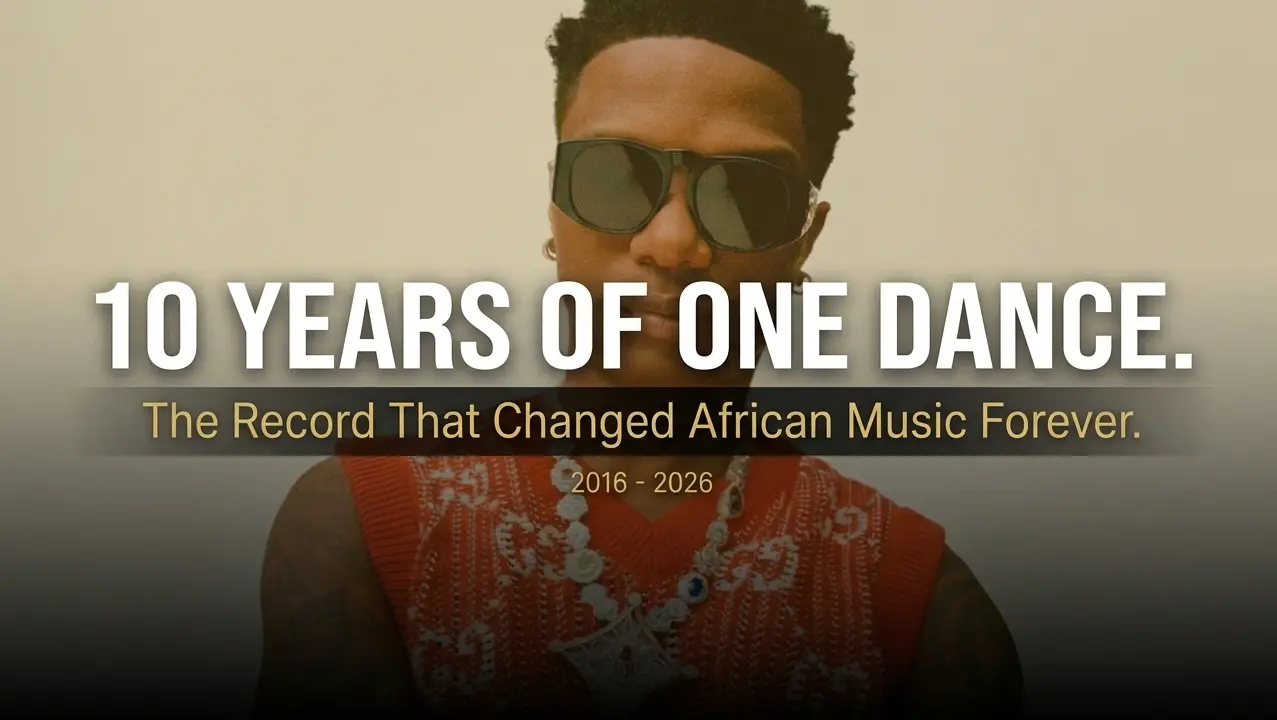
Four billion, two hundred and eighty-two million streams.
That is where "One Dance" sits on Spotify right now, a decade after Drake, Wizkid, and Kyla released a three-minute record that did not fully belong to any single genre and ended up belonging to the entire world. OkayAfrica
Most people remember "One Dance" as a Drake song. Some remember it as the record that introduced Wizkid to a global audience that was not yet ready for what African music was about to become.
Almost nobody talks about the producer.
"One Dance" was co-produced by DJ Maphorisa, a Pretoria-born producer who comes from the South African house subgenre known as Amapiano. Afrocritik
The man who helped build the record that opened the Western world's ears to African music in 2016 is the same man whose genre would become one of the most dominant sounds on the planet by the time "One Dance" turned ten.
That is not a coincidence. That is a decade of African musical architecture made visible in one biographical detail.
What April 6, 2016 Actually Was
In 2016, Drake was looking to evolve his sound and found himself diving into dancehall. "One Dance" dropped ten years ago and remains one of the most important records in his catalogue. Spotify
But the Western framing of "One Dance" as a Drake record with an African feature misses what was actually happening sonically and strategically inside the production.
Wizkid had stood at the forefront of Afrobeats' global penetration since "Ojuelegba," a song that charted his humble beginnings from a Lagos suburb and marked his international breakthrough, inspiring an official remix with Skepta and Drake. Drake felt the pulse of the song and knew its importance in the project he was working on. OkayAfrica
The key word is pulse. Drake did not feature Wizkid because he needed an African voice for marketing purposes. He featured Wizkid because Afrobeats had a rhythmic and emotional intelligence that was doing something to listeners that nothing else in the mainstream was doing in 2016. The groove was undeniable. The feeling was specific. And it was coming from a continent that the global music industry had spent decades treating as a footnote.
2016 was a watershed moment when African music transitioned from regional success to a powerful global force. The collaboration between Wizkid and Drake birthed a global hit and signalled a shift in how the world listened to African music, accelerating recognition of the abundant genres emerging from the continent and placing them firmly on the global stage. Spotify
The Decade That Followed
Ten years is long enough to see what a single record can unlock.
In 2016, Afrobeats was a genre that Western music executives were still asking their assistants to explain. By 2026, the Grammy Award for Best African Music Performance nominees include Burna Boy, Davido featuring Omah Lay, Eddy Kenzo and Mehran Matin, Ayra Starr featuring Wizkid, and Tyla. Afropop Worldwide
Wizkid is in the Grammy nominees a decade later. The genre he helped introduce to the world through "One Dance" now has its own Grammy category. The continent that was treated as a feature credit is now competing at the highest level of the industry's formal recognition structure.
And underneath the awards and the streaming numbers, something more structural changed.
Amapiano is moving from cool club trend to essential global dance language in 2026, much like house and techno did in earlier eras. The genre's log drum basslines and hypnotic synths have proven universally infectious, appearing in Afrobeats, R&B, and mainstream pop worldwide. YouTube
DJ Maphorisa, the man who helped build "One Dance," built a genre that is now genuinely global. The same production instincts that made a three-minute Drake record irresistible to four billion people also built the sonic architecture of Amapiano. These are not separate stories. They are the same story told a decade apart.
The New Sounds That 2016 Made Possible
The decade that "One Dance" opened did not produce one genre. It produced a continent's worth of sounds that finally had a global audience trained to receive them.
3-Step blends deep house, Amapiano, and Afro-tech, creating an electronic genre set to dominate the continent in 2026. The sound features robust horns, brazen bass, log drums, and rousing percussion central to all African music styles. Music executives predict this genre will drive underground club scenes from Lagos to Nairobi simultaneously. YouTube
Afro-house, the sound that earned its own OkayAfrica editorial section this year, is moving through East Africa with the same energy that Amapiano had in 2019 before it went everywhere. In South Africa, Lekompo and Bacardi house are staking a serious claim as the country's next export-ready sounds, rooted in specific communities yet engineered for wide circulation. Audiomack
Underground sounds are shaping Nigerian mainstream culture in 2026, building on the momentum sparked by Rema's genre-defying album Heis. As emerging artists push bold trap and Amapiano hybrids, Nigerian hip-hop is poised for a creative revival driven by innovative underground rappers. Tooxclusive
A trend of crate-digging to reimagine 1990s and early 2000s African classics into modern pop-driven hits is becoming a dominant production style in 2026, with genre now a line that is respected and more often creatively crossed. Apple Music
Every one of these movements exists inside a global music conversation that was not having this discussion before April 6, 2016.
"2026 Is the New 2016" and Why That Tag Is More True Than It Sounds
The realisation that a full decade has passed since 2016 has sparked a wave of nostalgia worldwide, with the viral tag "2026 is the new 2016" capturing a generation reliving that transformative year. For African music lovers, this nostalgia runs especially deep because 2016 marks a watershed moment that completely transformed the music's identity and its projection across the entire continent. Spotify
That viral tag is not just nostalgia. It is recognition of a cycle.
In 2016, African music was on the verge of something that most people inside the industry could feel but not yet name. The sounds were right. The talent was always there. What changed was access, distribution, and one specific collaboration that made the Western ear pay attention in a new way.
In 2026, the same conditions are assembling again but with a fundamentally different power dynamic. African artists are not waiting to be featured on a Western record to access global audiences. They are building global audiences directly through streaming platforms that do not care about geography. They are releasing independently, owning their masters, and letting the algorithm find their listeners across continents without asking anyone's permission.
Wizkid's feature on Drake's "One Dance" cemented his role as one of Afrobeats' chief ambassadors. What followed was a deliberate push into global markets, embracing versatility across EDM, dancehall, and Afrobeats' irresistibly airy grooves. GRAMMY
The artists who understood that lesson, that the goal is not to wait for a Western co-sign but to build something so specific and so excellent that the co-sign becomes optional, are the ones defining African music in 2026.
Burna Boy built it. Tyla built it. Ayra Starr built it. Wizkid started building it in a Lagos suburb with a group called Glorious Five at eleven years old, long before Drake knew his name.
What This Means for Every Independent African Artist Building Right Now
The "One Dance" anniversary is not just a cultural moment to reflect on. It is a practical instruction manual for what works.
The record worked because the production was right. Because the African musical intelligence inside the beat was specific and authentic and not diluted for palatability. Because the artist on it was someone who had been building long before the opportunity arrived and was therefore ready when it did.
Ten years later the tools available to an independent artist in Nairobi, Dar es Salaam, Lagos, or Accra are more powerful than anything Wizkid had access to when he was recording "Ojuelegba" in Lagos. Distribution is global and immediate. Streaming algorithms reward quality regardless of where the artist lives. Playlist curators at Spotify and Apple Music are actively looking for the next wave of African sound because their data tells them that is where their listeners are moving.
The only question is whether the music is built on a foundation solid enough to compete at that level.
The beat is where that foundation begins. The licence is what makes everything built on top of it actually yours.
At mBeatz, the catalogue carries the DNA of the sounds that the last decade of African music built. Afro-pop, Bongo Flava, Afro-house, Amapiano-influenced, Afrobeats, and everything in between. Every beat delivered instantly in full WAV quality with a licence document that means every stream belongs to the artist from the first play.
The next ten years of African music are being built right now, one record at a time, by artists who understood the lesson of "One Dance" without needing anyone to explain it to them.
The lesson is simple. Build something real. Build it on the right foundation. Let the world catch up.
Start building at mBeatz today. Browse the full catalogue here.
.jfif)
0 Comments
Leave a Comment