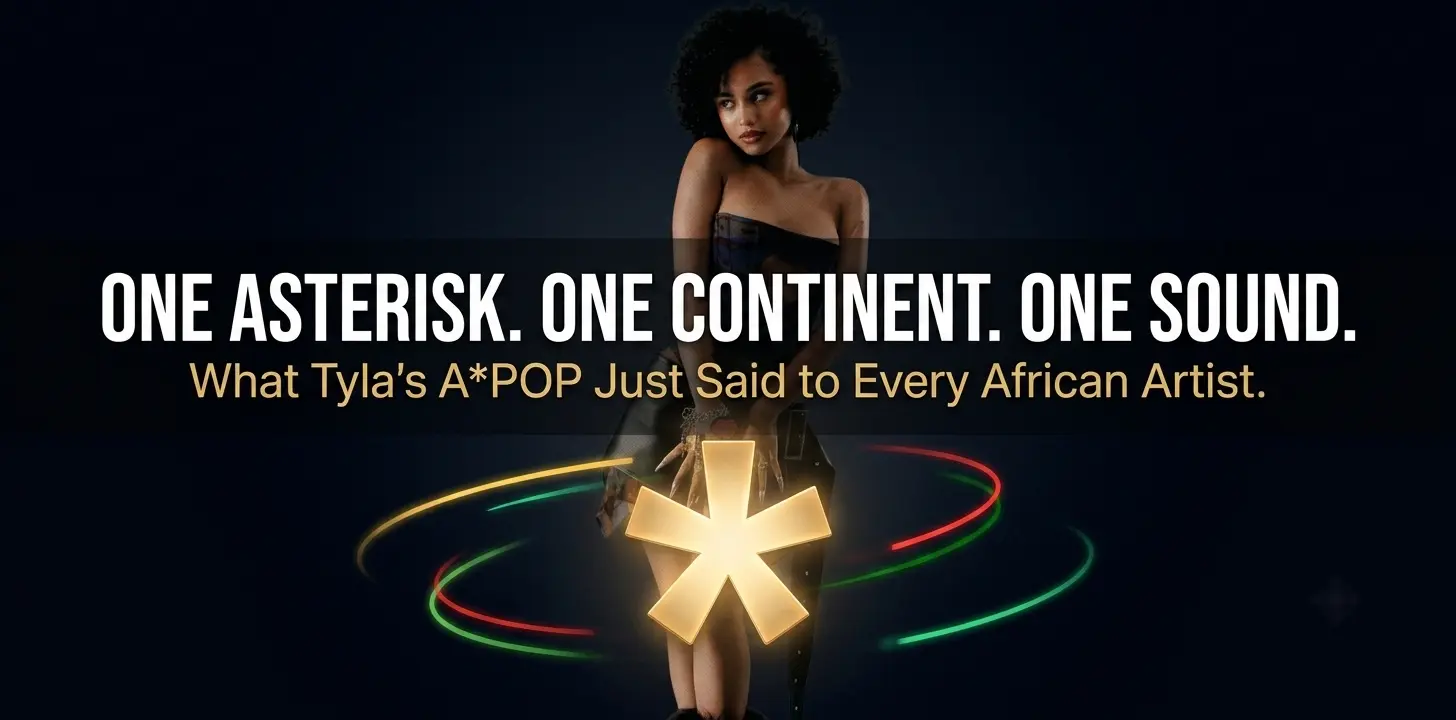
It is one character.
One asterisk. Sitting between the A and the POP in the title of the most anticipated African album of July 2026.
In an exclusive interview about the reception of her latest project "A*POP," Tyla spoke about her navigation of the space between different sides of herself and her unshakeable commitment to her South African roots. OkayAfrica
A*POP. Not Afro-pop spelled out. Not a genre label borrowed from the music press. A new word entirely, built from the existing one, claiming its own space with a single typographical decision that announces: this is something the old category was not wide enough to hold.
That asterisk is doing more work than any press release, any marketing campaign, or any radio rollout could do. It is telling the global music industry that the South African artist who just won the Grammy for Best African Music Performance, who TikTok Kenya is celebrating today with an exclusive in-app experience, who OkayAfrica sat with for a cover interview this week, has decided that the genre that made her does not fully describe what she is making anymore.
So she made a new word for it.
And in doing so she gave every African artist on the continent permission to do the same.
What A*POP Actually Is
Tyla's A*POP navigates the space between different sides of herself, the South African girl from Johannesburg and the global pop star who sold out arenas, without resolving that tension into something comfortable or easy to categorize. OkayAfrica
That refusal to resolve is the most radical thing about the album and the most instructive thing for every artist building right now.
The music industry, in every country and every era, exerts enormous pressure on artists who have crossed from regional success into global visibility to smooth themselves out. To become more palatable. To file down the edges that make them specifically from somewhere and become generally from everywhere instead.
Tyla looked at that pressure and named it. Then she rejected it with a punctuation mark.
The asterisk in A*POP is a footnote reference. In academic writing, an asterisk points to a clarification, a condition, an exception to the stated rule. Tyla's asterisk says: this is pop, but with a condition attached. The condition is Johannesburg. The condition is South Africa. The condition is the specific identity that the generic category of pop does not fully accommodate and that she has no intention of removing from her music to make it easier to file.
That is not a marketing concept. That is an artistic philosophy. And it is one that every African artist navigating the tension between local identity and global ambition can read as a direct instruction.
The Three Countries This Album Connected in One Week
The A*POP release this week did something that only the biggest African records manage. It activated conversations in multiple countries simultaneously that were all about the same thing but arrived from completely different directions.
In South Africa, the conversation is about a Johannesburg girl who won a Grammy and came back with an album that doubles down on where she came from rather than trading it in for where she arrived.
In Kenya, TikTok is celebrating Tyla's APOP with an exclusive in-app experience giving fans new ways to engage with the album. The Kenyan TikTok audience, which is one of the most active music-discovery communities on the continent, is not engaging with APOP as a foreign record from a neighbouring country's artist. They are engaging with it as their sound, as music that belongs to the East African ear as much as the South African one, because the Afro-pop tradition Tyla builds from has always moved freely across the borders that colonial mapmakers drew and musicians have always ignored. OkayAfrica
And in Nigeria, the cross-border energy this week has its own chapter. Yemi Alade and Bien dropped "Don't Be Shy" this month, a Nigeria-Kenya collaboration where Yemi brings her usual confidence and Bien slides in with the smoothness that has made him one of East Africa's most reliable collaborators. Beats of Africa
Nigeria and Kenya. South Africa and Kenya. The entire continent leaning toward its own music this week with an intensity that does not feel like trend-following. It feels like recognition.
The Genre Conversation That A*POP Just Opened
The asterisk matters beyond Tyla's personal artistic statement because it arrives at a moment when the category of Afro-pop is under genuine definitional pressure from multiple directions.
Amapiano has its own identity now. Afro-house has its own identity. Bongo Flava has always had its own identity. Gengetone is specifically and defiantly Kenyan. The umbrella of Afro-pop has been covering an increasingly wide and diverse range of sounds from an increasingly wide and diverse range of countries, and the artists making those sounds are increasingly unwilling to have the specificity of their work flattened into a single genre label for the convenience of playlist curators and streaming algorithm categories.
This month's best West African songs list from Nigeria, Ghana, Senegal and Benin is described as an exciting and truly diverse selection of indie talent, romantic stories, and energetic comebacks, with diss tracks that land with a sting, romantic duets that open the coldest hearts, and one man's deep love for the beauty of his country. OkayAfrica
Benin. Senegal. Ghana. Nigeria. Four countries, four specific cultural contexts, four distinct relationships to the Afro-pop umbrella, all producing music this month that is simultaneously deeply local and genuinely continental.
Tyla's asterisk says: the umbrella is fine, but I am also something more specific than it. And every artist on this continent making music that is more specific than the category it gets filed under has been waiting for someone with her platform to make that statement clearly enough for the industry to hear it.
What East Africa Sounds Like Right Now Beside All of This
July's strongest East African songs leaned into experimentation and carried an underground feel, from SaiSounds' Somali House to Bolingo's unexpected turn toward rock, with what stands out this month being how much the region's sound is expanding and widening. Beats of Africa
Somali House. Rwandan hip-hop with Dylack, Og2tone and Cracs Got Real on R.M.H's "Imbobo." Burundian Drama T keeping momentum with "Iholele." The East African sound in July 2026 is not consolidating around a single direction. It is expanding in every direction simultaneously, with artists from countries that rarely appeared on continental music roundups now producing work that OkayAfrica and Apple Music and Spotify editorial teams are actively tracking and featuring.
That expansion is exactly what Tyla's asterisk validates. Every artist who has felt the pressure to sound more like the established genre and less like the specific place they come from has a new reference point this week. A South African woman who won the continent's first Grammy in the pop category looked at the pressure to become generic and made a new word instead.
The Somali House producer in Mogadishu who is blending coastal rhythms with electronic architecture. The Burundian artist building confidence without forcing the point. The Rwandan hip-hop collective enjoying itself. Every one of them is making an A*POP-shaped decision even if they have not heard the album yet.
What This Moment Requires Practically
The widening and expanding that is happening across African music in July 2026 is exciting as a cultural story. It is also a practical challenge for every artist in the middle of building something.
Expanding sounds require production infrastructure that can hold the expansion. A Somali House beat is not the same as a Bongo Flava beat. A Rwandan hip-hop instrumental is not the same as a Kenyan Afro-pop production. The genre vocabulary is widening and the production tools available to each artist need to match the specific sound they are trying to make rather than offering a generic approximation of it.
The artists winning in this environment are the ones who start with the right beat, the one that carries the specific cultural DNA of the sound they are reaching for, not a close enough substitute that undermines the specificity at the foundation.
At mBeatz, the catalogue carries the East African sound in its full width. Afro-pop, Bongo Flava, Afrobeats-influenced, Afro-house, Afro-R&B, and every genre expanding beyond those categories right now across the region. Every beat produced by human producers who understand that the specificity of a sound is not an obstacle to clear commercial appeal. It is the source of it.
Tyla's asterisk proved that this week to an audience of hundreds of millions.
Pay with MPesa, Airtel Money, Visa, Mastercard, Apple Pay, PesaPal, or bank transfer from anywhere on the continent and beyond. Instant WAV delivery. Proper licence included.
Browse the mBeatz catalogue at mbeatz.org and find the beat that is specific enough to be yours.
Which African album released in 2026 has changed how you think about your own sound? Drop it in the comments.
.jfif)

.jfif)
0 Comments
Leave a Comment