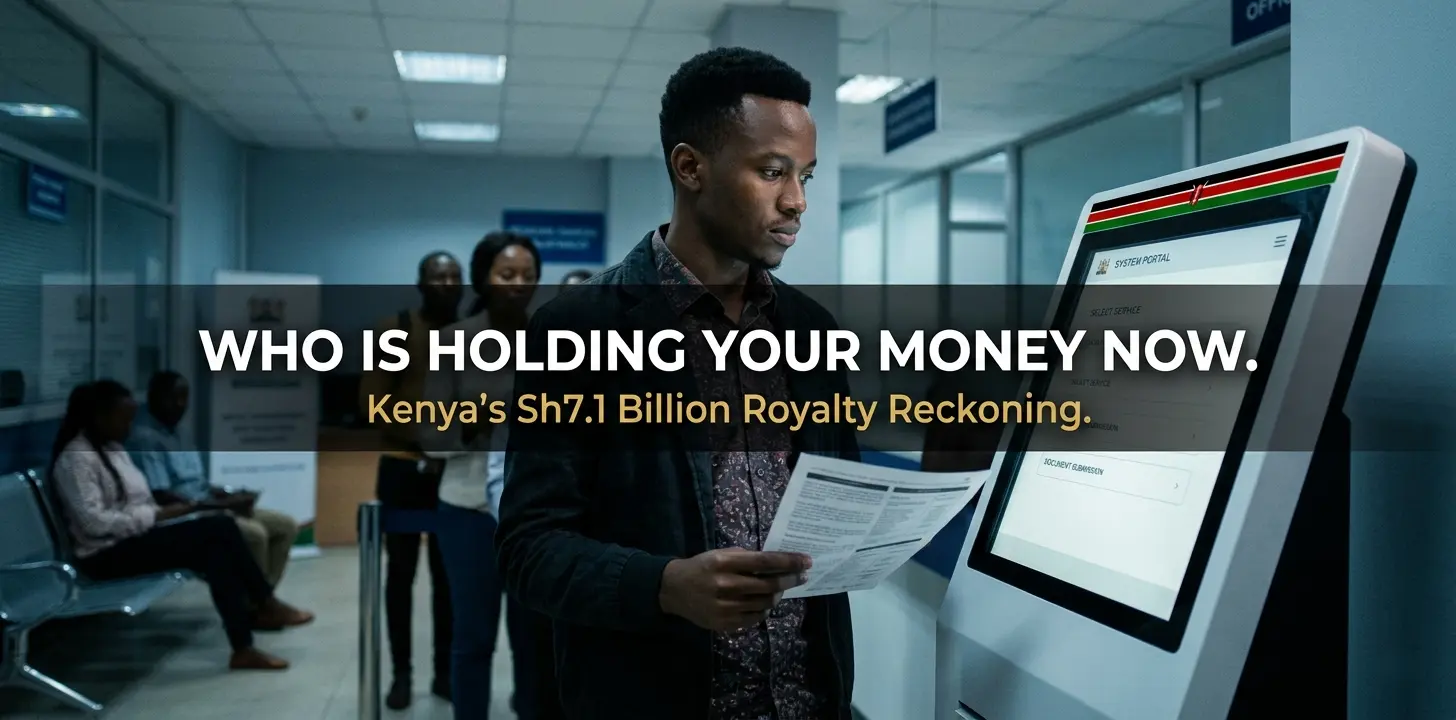
Seven point one billion shillings.
That is the estimated amount Kenya's music industry loses every single year due to deep-rooted weaknesses in copyright protection, enforcement, collective rights management, and royalty payment systems, according to a new report by the Music Economy Development Initiative. Wikipedia
Fifty-five million dollars. Vanishing annually. Not stolen in one dramatic heist, but leaking continuously through a system so structurally compromised that an entire generation of Kenyan artists has learned to expect close to nothing from the royalties they are legally owed.
The government has finally responded. And the response has set off the most consequential fight in Kenyan music policy in years.
What Just Happened
President William Ruto has ordered all music royalty collections to move to the eCitizen platform, despite fierce resistance from collective management organisations. Wikipedia
In April, the Kenyan government revealed it is targeting to collect an average of Sh3 billion yearly in music royalties via eCitizen, following years of complaints of mismanagement and embezzlement of millions of shillings in royalty collections by CMOs. Wikipedia
Read those two numbers side by side. Sh7.1 billion lost annually under the current system. Sh3 billion targeted for collection through the new one. The government is not promising to fix everything overnight. It is promising to recover less than half of what is currently disappearing, and even that lower number represents the most ambitious royalty reform Kenya has attempted in decades.
This did not happen in isolation. It happened five months after this blog covered MCSK's licence being revoked by KECOBO, after sixteen thousand artists were left without a functioning collection body, after a High Court hearing was scheduled for July to determine what comes next. The eCitizen directive is the government's answer to a vacuum that the MCSK collapse exposed publicly and undeniably.
Why the System Was Losing That Much Money
The Sh7.1 billion figure covers both copyright and neighbouring rights revenues across the music value chain, reflecting income from digital platforms such as Spotify, Deezer and Amazon Music, performance rights generated through radio and television broadcasts, rebroadcasting and retransmission services, background music licensing, private copying levies, synchronisation deals, and other licensing streams. Wikipedia
Every one of those revenue categories represents money that Kenyan songwriters, performers, publishers, and producers are legally entitled to. Every category is also a place where the current system has historically failed to collect, track, or distribute funds accurately.
According to KECOBO senior legal counsel Alex Omanga, the structural problem sits inside the legal regime itself. Collective Management Organisations are private companies, member-driven, that do not belong to the government. They obtain a permit from KECOBO to collect royalties, but when problems arise within a CMO, its own members are responsible for holding board members accountable, not the regulator. Wikipedia
That explanation lands like a confession. The regulatory body overseeing Kenya's entire royalty collection system is openly acknowledging that it has limited power to intervene when a CMO mismanages funds, because the legal structure places accountability inside member organisations that have repeatedly failed to police themselves.
This is precisely what happened with MCSK. Failure to submit certified annual returns and audited accounts for five consecutive years, accusations of failing to account for Ksh 56 million in artist royalties, and a licence that KECOBO ultimately refused to renew. Afrocritik
The CMO system was not designed with enough teeth to prevent exactly the failure that just happened.
The CMOs Are Fighting Back, and Their Argument Deserves a Hearing
Richard Sereti, Acting CEO of the Music Copyright Society of Kenya, pushed back directly. "No government in the world collects royalties on behalf of artists, and this is regarding government collecting royalties via eCitizen, a job meant for CMOs. The CMOs have a memorandum of association with the artists they represent. The government's role is to enable and support the CMO in enforcing and ensuring compliance for effective collection, but this hasn't been happening, which is why we are losing money." Wikipedia
This is not an unreasonable position. Globally, royalty collection is typically handled by specialised collecting societies precisely because the work requires industry expertise, granular rights tracking, and direct relationships with the creative community that a general government platform was not originally built to manage. Sereti's argument that government interference, rather than government absence, is part of the problem deserves to be taken seriously rather than dismissed as simple institutional self-preservation.
But that argument has to be weighed against what actually happened under CMO management. Five years of missing audited accounts is not a story about government overreach. It is a story about an absence of internal accountability that the existing structure was supposed to prevent and did not.
Both things can be true simultaneously. The CMO model has theoretical advantages that a government platform may struggle to replicate. The CMO model in Kenya specifically has also failed catastrophically enough, recently enough, and publicly enough that the government's intervention has broad public sympathy regardless of the theoretical merits on either side.
The Cross-Border Comparison That Makes This Sting
Across the border, a mirror initiative in Tanzania has generated double the revenue of Kenya's equivalent blank tape royalty system, while local Kenyan creatives cannot access a single cent of their frozen funds. Wikipedia
Sit with that comparison for a moment. The same category of royalty, run through a comparable system, in a neighbouring East African country, is generating double the revenue and reaching the creators it is meant to reach. Kenya's version of the same mechanism has frozen entirely, with millions of shillings sitting inaccessible to the artists who earned them.
This is not a story about Kenyan music underperforming Tanzanian music. The streaming numbers, the chart performance, the cultural export power all tell a different story entirely. This is a story about institutional infrastructure, and on that specific metric, Tanzania's system is currently outperforming Kenya's by a significant and measurable margin.
That comparison is uncomfortable. It is also exactly the kind of pressure that tends to accelerate genuine reform rather than allow a problem to drift indefinitely.
What This Means for You Right Now
If you are a Kenyan artist, producer, songwriter, or publisher, here is the practical reality of where things stand today.
The eCitizen royalty collection system is being built and rolled out, but it is not yet the complete, functioning replacement for the CMO ecosystem. The MCSK legal situation remains unresolved with a full hearing scheduled for July 21, 2026. The eCitizen directive and the MCSK court case are two separate but deeply connected threads of the same underlying crisis, and neither has fully resolved as of today. GRAMMY
What this means practically: do not assume any single collection mechanism, whether the old CMO structure or the new government platform, is currently capturing all the royalties you are owed. Lawsuits are already surfacing around exactly this kind of gap, including a recent case where an artist sued his record label over Sh87.6 million in disputed royalties and copyright control, alleging the label took control of his digital catalogue and issued malicious copyright strikes whenever he tried to release new music independently. Wikipedia
The pattern across every one of these stories, MCSK, the eCitizen directive, the frozen blank tape royalties, the Sh87.6 million dispute, is the same. Kenyan artists who do not have clear, independent documentation of what they own are the ones most exposed when institutional systems fail or shift.
The One Thing That Survives Every Institutional Crisis
Here is what does not depend on whether eCitizen succeeds, whether the CMOs reform, or what the High Court decides on July 21.
Your streaming royalties from Spotify, Apple Music, Boomplay, and Audiomack flow through your distributor directly, not through MCSK, PAVRISK, or eCitizen. That income stream is structurally separate from the collective management crisis currently dominating headlines.
But that protection only holds if the underlying record was built with clean documentation from the start. A track recorded over an unlicensed beat, distributed without clear ownership paperwork, sits exposed to exactly the kind of dispute that produced the Sh87.6 million lawsuit referenced above, regardless of what happens with government royalty reform.
The macro story is the government and the CMOs fighting over a broken collection system. The micro story, the one each individual artist actually controls, is whether their own catalogue has a clean paper trail from the very first beat they ever licensed.
At mBeatz, every instrumental comes with instant WAV delivery and a full licence document. While Kenya's institutions work through the largest royalty reform in years, the artists building their catalogues correctly today are the ones who will have the cleanest claim to whatever system eventually emerges from this fight.
You cannot control whether eCitizen works. You can control whether your own music is built on paperwork solid enough to survive any system that comes next.
Start your catalogue with a properly licensed beat at mBeatz today.
.jfif)

.jfif)
0 Comments
Leave a Comment